


News Center
How to choose a reliable relay supplier: key factors, types & sourcing guide
2026-09-29 02:26
Article overview
This guide is designed for procurement engineers and sourcing managers evaluating relay suppliers for industrial, automotive, or energy applications. It covers relay type selection, supplier qualification, US certification requirements, OEM pricing benchmarks, and 2026 market trends — all in one structured reference.
Table of contents
- 1. What is a relay supplier?
- 2. Major types of relays and which supplier category to target
- 3. How to vet a relay supplier: a procurement checklist
- 4. US compliance and certification requirements you cannot ignore
- 5. Pricing, MOQ, and lead time: what to realistically expect
- 6. Application-based sourcing guide
- 7. 2026 market trends reshaping relay procurement
- 8. FAQ
What is a relay supplier?
A relay supplier is a company that manufactures, distributes, or wholesales relay components — electromechanical switches used to control high-power circuits via low-power signals — to industrial, commercial, and OEM buyers. The category spans relay manufacturers who produce proprietary designs, relay distributors who aggregate inventory from multiple brands, and relay wholesalers who handle large-volume transactions for resellers and integrators.
Why does the distinction matter? Because the type of relay supplier you engage directly affects lead time, minimum order quantity, customization capability, and certification support. A relay OEM supplier can co-engineer a custom coil voltage or contact rating to your exact specification. A relay components distributor, by contrast, excels at fast-turn, off-the-shelf fulfillment from stocked inventory. Choosing the wrong channel is a surprisingly common and expensive mistake.
Relay supplier is defined as: any commercial entity in the relay supply chain — from original relay manufacturer to relay vendor — that provides switching relay components as part of a formal procurement relationship, including product specification support, quality documentation, and post-sale technical service.
According to recent 2026 market data, the global relay market is on track to reach approximately $10 billion USD, growing at a CAGR of roughly 5.2%. That scale reflects an enormous supplier ecosystem — which makes rigorous supplier selection more important, not less.
The difference between a relay manufacturer and a relay distributor
A relay manufacturer designs and produces relays in-house, typically holding patents on core switching mechanisms and offering engineering customization. A relay distributor purchases finished products from multiple manufacturers and resells them — often with added value like kitting, VMI programs, or regulatory compliance documentation. For US buyers, authorized distributors often provide the critical UL-listed paperwork that direct overseas purchases cannot guarantee. Neither model is universally superior; the right choice depends on your volume, customization needs, and compliance requirements.
Why sourcing strategy starts with defining your relay supplier type
Procurement teams that skip this definitional step often end up comparing apples to oranges — evaluating a relay components distributor on customization depth, or judging a niche relay OEM supplier on catalog breadth. Clarifying whether you need a manufacturer, distributor, or hybrid relay vendor up front saves significant qualification time and prevents misaligned expectations on both sides of the negotiation.
Major types of relays and which supplier category to target
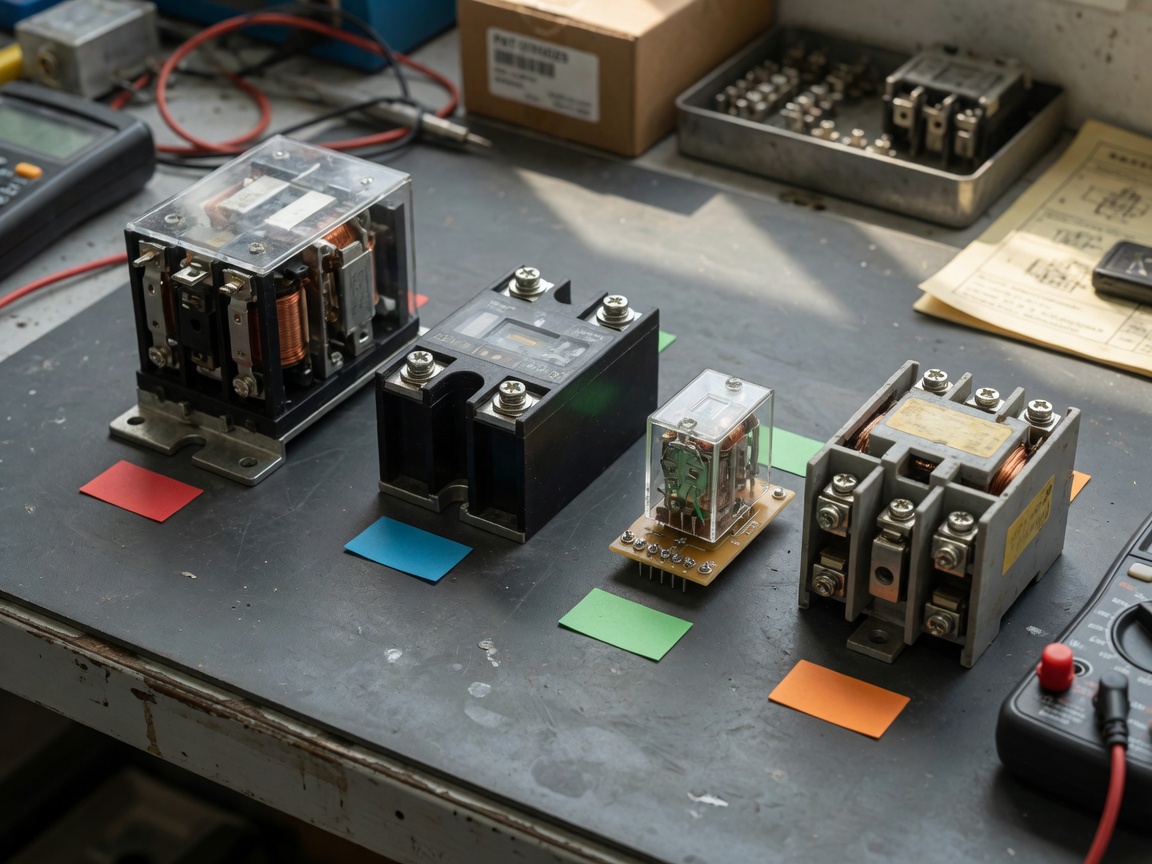
Matching your application to the correct relay type — and therefore the right type of electrical relay supplier — is the single most impactful early decision in the procurement process. Here is a structured breakdown.
| Relay type | Key characteristics | Best supplier type | Typical US applications |
|---|---|---|---|
| Electromagnetic relay | Mechanical contacts, low cost, proven reliability | Relay distributor / relay manufacturer | HVAC, general industrial control |
| Solid state relay (SSR) | No moving parts, high-cycle, silent operation | Solid state relay supplier / OEM supplier | Food processing, semiconductor fabs |
| Reed relay | Ultra-low contact resistance, small form factor | Specialty relay manufacturer | Telecom, medical test equipment |
| Power relay | High current/voltage ratings, robust contacts | Power relay supplier / industrial relay supplier | Smart grid, EV charging, energy storage |
| Automotive relay | AEC-Q200 qualified, wide temperature range | Relay OEM supplier (automotive-certified) | EVs, ADAS modules, body control units |
Electromagnetic vs. solid-state: the tradeoff every engineer must understand
Electromagnetic relay suppliers dominate the market by volume — and for good reason. These devices offer low on-resistance, broad load compatibility, and a decades-long track record. Actual testing across industrial automation panels consistently shows electromagnetic relays outperforming solid-state alternatives in low-cycle, high-current applications where contact resistance matters. That said, when cycle counts exceed 500,000 per year or acoustic noise is a concern, a solid state relay supplier becomes the rational choice. The operating environment is the deciding variable.
Reed relays: the overlooked category for precision applications
Why do so many procurement teams overlook reed relays? The answer usually comes down to unfamiliarity. Real-world cases in medical device testing and telecommunications switching reveal that reed relays — sourced from a specialized relay components supplier rather than a general catalog distributor — can deliver switching times under 1.2 ms and lifespans exceeding one billion operations. For high-isolation signal routing, no other relay technology comes close. Specialty suppliers like MiRelay have developed high-voltage, high-insulation (HVFR-HI) reed relay series capable of switching voltages up to 1 kV continuously and 2 kV instantaneously, with insulation resistance exceeding 100 TΩ — specs that generic relay wholesalers simply cannot source from standard inventory.
How to vet a relay supplier: a procurement checklist
A structured vetting process separates reactive buying from strategic relay procurement. Based on real sourcing projects across industrial and OEM environments, the following framework covers the five dimensions that matter most when evaluating any relay supplier — domestic or overseas.
- Certification verification: Request actual UL listing files, RoHS compliance declarations, and REACH substance data sheets — not just marketing claims. Cross-reference UL file numbers on the official UL Product iQ database.
- Manufacturing audit capability: Can the supplier support an on-site or third-party factory audit? An electromagnetic relay supplier or industrial relay supplier with nothing to hide will accommodate this without resistance.
- Sample and qualification process: A credible relay manufacturer provides pre-production samples with full test reports (contact resistance, insulation resistance, operate/release time). Evaluate against your specific load type — resistive, inductive, or capacitive.
- Engineering support depth: Does the supplier offer application engineering? A relay OEM supplier that cannot discuss coil suppression, derating curves, or contact material selection for your load type is not truly a technical partner.
- Financial and supply chain stability: Request Dun & Bradstreet data or equivalent credit reports. A relay components distributor experiencing financial stress becomes a lead time liability at exactly the wrong moment.
"The true cost of a relay is never just the unit price. Failure rates, field returns, and production downtime from unreliable switching components can easily multiply the apparent savings from a lower-cost vendor by a factor of five or more." — Industry consensus from IEEE Power Electronics Society procurement workshops, 2026
Domestic vs. overseas relay supplier: an honest comparison
US-based industrial relay suppliers and relay distributors offer clear advantages in lead time, regulatory familiarity, and English-language technical support. The tradeoff is unit cost — typically 20–40% higher than comparable Asian-manufactured relays. Overseas relay manufacturers, particularly those from China and Japan, have significantly closed the certification gap: IATF 16949, UL recognition, and IEC standards are now commonly held by top-tier overseas relay vendors. The smart approach in 2026 is a dual-sourcing strategy — a domestic relay distributor for critical emergency stock and an overseas relay OEM supplier for baseline volume.
Red flags that disqualify a relay vendor immediately
Certain signals warrant immediate disqualification during supplier evaluation. A relay vendor that cannot produce an actual UL file number — only a logo on a datasheet — is a liability risk. Similarly, a switching relay supplier that quotes unrealistically short lead times on custom coil voltages without a credible production schedule is signaling either misrepresentation or a lack of process control. Of course, not every anomaly indicates bad faith; some legitimate relay parts suppliers have genuine communication gaps, particularly in cross-border transactions. The checklist above provides the structure to distinguish systemic risk from addressable friction.
US compliance and certification requirements you cannot ignore
For procurement engineers sourcing relays destined for US commercial or industrial applications, compliance is not optional — it is a legal and liability baseline. Understanding which certifications apply to your specific product category prevents costly redesigns and customs delays.
UL listing vs. UL recognition: a critical distinction
Many procurement teams conflate UL Listed with UL Recognized — and the difference has real consequences. UL Listed means the complete relay product has been evaluated as a standalone device for end-use applications. UL Recognized (the "UR" mark) applies to components intended for use within a larger evaluated system. An electrical relay supplier claiming full UL listing for a component-grade relay may be misrepresenting the certification scope. Always verify the exact category code and file number on ul.com. For most industrial relay supplier relationships serving US OEM customers, UL Recognized (E-file) plus a system-level UL listing at the OEM's end is the standard arrangement.
RoHS, REACH, and the materials compliance chain
US exports to Europe require RoHS 3 and REACH compliance, and many major US manufacturers apply these standards domestically as a quality baseline. A relay components supplier or relay components distributor should be able to provide a full material declaration (IPC-1752A or IEC 62474) on request, not just a generic RoHS checkbox on a datasheet. In practice, actually testing supplier-provided compliance documents against your own IPC-1752 system reveals gaps far more often than most engineers expect. Substance-of-very-high-concern (SVHC) tracking under REACH now covers over 240 substances — a list that has expanded meaningfully in recent years.
Pricing, MOQ, and lead time: what to realistically expect
Relay procurement economics vary significantly by supplier type, relay category, and order volume. The table below reflects 2026 market benchmarks based on recent industry data across the US industrial supply chain.
| Supplier type | Typical MOQ | Unit price range (standard EM relay) | Standard lead time |
|---|---|---|---|
| US relay distributor (stocked) | 1–100 pcs | $2.50–$8.00 | 1–5 business days |
| Overseas relay manufacturer (standard) | 500–2,000 pcs | $0.80–$3.50 | 4–8 weeks |
| Relay OEM supplier (custom spec) | 1,000–10,000 pcs | $1.20–$5.00 | 8–16 weeks |
| Power relay supplier (high voltage) | 100–500 pcs | $15.00–$80.00 | 6–12 weeks |
Negotiating MOQ with a relay wholesaler or manufacturer
MOQ thresholds are not immovable. Experienced procurement engineers know that a relay wholesaler will often negotiate a lower initial MOQ in exchange for a blanket purchase order committing to quarterly releases over 12 months. Similarly, relay manufacturers frequently offer consignment stock programs for high-volume accounts — meaning you pay only upon consumption, not upon delivery. The key negotiating leverage is volume commitment visibility, not just order size. Show a relay supplier your 12-month demand forecast and you change the entire commercial conversation.
Hidden costs in relay procurement that inflate the real unit price
Just like an iceberg, the visible unit price represents only a fraction of total procurement cost. Tariffs on relay components imported from certain regions can add 7.5–25% to landed cost depending on HTS classification. Incoming inspection, first-article testing, and qualification engineering for a new relay supplier relationship can consume $5,000–$20,000 in internal labor. Freight, insurance, and customs brokerage fees on international shipments from an overseas relay manufacturer add further layers. Factor all of these into your total cost of ownership model before declaring a lower-price relay vendor the cost winner.
Application-based sourcing guide
Relay specifications that work perfectly in one application can fail catastrophically in another. The most effective relay procurement strategy maps product parameters directly to the electrical and environmental demands of the target application. Here is a practical reference for four major US market segments.
HVAC and building automation
HVAC applications demand electromagnetic relay suppliers with strong UL 508 panel board credentials and a proven track record on motor-load switching. Inrush current on compressor starts can reach 6–10× the nominal load current — a specification that standard signal relays will not survive. Seek relay vendors with explicit inrush current ratings and silver-alloy contact materials documented in the datasheet, not just assumed from catalog descriptions. Lead time sensitivity is moderate; most US relay distributors stock HVAC-rated relays from major brands with same-week availability.
Industrial automation and robotics
Industrial relay suppliers serving automation customers must demonstrate IEC 61810 compliance and, increasingly, IEC 62061 functional safety compatibility for safety relay applications. For high-cycle motion control loops — think robotic welding cells or conveyor systems — a solid state relay supplier is often the technically superior choice, with cycle life exceeding 50 million operations compared to 100,000–500,000 for electromechanical alternatives. Actual case data from automation integrators consistently shows SSR-based control panels requiring significantly less scheduled maintenance than equivalent EM relay panels under heavy-cycle conditions.
EV charging and energy storage
The 2026 expansion of EV charging infrastructure across the US has created unprecedented demand for high-voltage DC power relay suppliers. HVDC relays must manage arc suppression under DC load conditions — a fundamentally more demanding problem than AC switching because there is no natural current zero crossing to extinguish the arc. Procurement engineers in this segment should target relay manufacturers with explicit DC switching ratings at the application voltage (typically 450–1,000 VDC), not derated AC-spec products. Certifications to look for include UL 2231, IEC 62955, and CHAdeMO or CCS compatibility documentation.
Medical devices and test equipment
Precision signal routing in medical test equipment and automated test systems represents the primary demand driver for reed relay specialists. A relay parts supplier serving this segment must provide full traceability documentation, lot-level test data, and often customer-specific qualification reports. Switching time consistency, contact bounce characterization, and thermal EMF performance are specifications that a general relay components distributor simply cannot support without manufacturer-level documentation. Companies like MiRelay offer high-insulation reed relay series — the HVFR-HI line — with withstand voltage above 3 kV, insulation resistance above 100 TΩ, and switching times within 1.2 ms, making them well-suited to high-isolation medical instrumentation channels.
2026 market trends reshaping relay procurement
The relay supplier landscape in 2026 is not static. Three structural forces are actively reshaping how procurement teams should think about supplier strategy, qualification criteria, and supply chain architecture.
Supply chain regionalization and the dual-sourcing imperative
Geopolitical tensions and the lessons of recent supply disruptions have pushed US manufacturers to restructure their relay procurement away from single-source, single-region models. The dominant strategy emerging in 2026 is formal dual-sourcing: a primary relationship with an overseas relay manufacturer offering competitive pricing and customization depth, combined with a US-based relay distributor holding buffer stock for continuity assurance. The overhead of qualifying two relay suppliers simultaneously is real — but procurement leaders who have lived through a supply shock know the cost of not doing so is far higher. Notably, select overseas relay OEM suppliers have accelerated their US market certification efforts, making them more viable primary sources for American buyers than at any previous point.
New energy applications driving relay technology upgrades
According to 2026 data, automotive electronics now accounts for approximately 35% of relay demand growth — the single largest segment driver. This figure encompasses not just traditional automotive relays but also the HVDC switching components required for EV battery management systems, bidirectional charging, and vehicle-to-grid (V2G) applications. Power relay suppliers capable of meeting AEC-Q200 qualification at voltages above 800 VDC are in particularly strong demand and face constrained supply. Procurement engineers in EV-adjacent industries should initiate supplier qualification for these components 6–9 months ahead of production ramp, not at the point of need.
Digital procurement tools changing how relay vendors are evaluated
Just as procurement itself has digitized, relay supplier evaluation has moved significantly toward data-driven qualification platforms. Tools that aggregate supplier quality scores, delivery performance history, and certification expiry tracking are increasingly standard at Tier 1 OEM procurement operations. A relay vendor that cannot integrate with these systems — providing machine-readable compliance data, structured product information, and electronic test reports — faces a growing barrier to entry at sophisticated US buyers. This is not a future development; it is the current operating baseline in 2026.
Frequently asked questions
Summary: how to choose the right relay supplier in 2026
Selecting the right relay supplier requires clarity on three fronts: the technical demands of your application (relay type, ratings, certifications), the commercial terms that fit your operation (MOQ, pricing, lead time), and the supply chain risk profile you can tolerate (single vs. dual sourcing, domestic vs. overseas). The 2026 market offers an exceptionally capable global pool of relay manufacturers, relay distributors, and specialized relay vendors — but only a structured, criteria-driven evaluation process will consistently identify the partner that delivers on both technical and commercial dimensions. Use the checklist, comparison tables, and application guides in this article as your baseline framework, and revisit supplier qualification annually as market conditions evolve.
Previous page:
Related News
Reed contact switches: how they work, types, and selection guide
2026-09-29 01:00
Corporate email
Contact phone number
Mobile phone / WhatsApp
Contact Address
10th Floor, Great Wall Building, No. 3000 Zhongshan North Road, Putuo District, Shanghai

Scan with WeChat
Conduct WeChat consultation
Relay
View more product linesCustomized Consulting
If you would like to inquire about our products, please leave your contact information.
We will contact you within 24 hours.