



News Center
Normally closed reed switch: how it works, types, and wiring guide
2026-09-25 02:19
Article overview
This guide delivers a complete technical and procurement reference for the normally closed reed switch in 2026. It covers operating principles, model specs, wiring instructions, troubleshooting, technology comparisons, and US compliance requirements — all in one place.
Table of contents
- 1. What is a normally closed reed switch?
- 2. How does a normally closed reed switch work?
- 3. Types of NC reed switches: a complete breakdown
- 4. NC reed switch spec comparison: top models side by side
- 5. Step-by-step wiring guide for common US applications
- 6. Troubleshooting normally closed reed switch failures
- 7. NC reed switch vs. alternative technologies
- 8. UL/CE certification and compliance for US buyers
- 9. FAQ
What is a normally closed reed switch?
A normally closed reed switch is a hermetically sealed, passive magnetic sensor whose internal contacts remain closed — conducting current — until an external magnetic field of sufficient strength forces them open. Remove that magnetic field, and the contacts snap back to their default closed position automatically.
This "fail-safe closed" behavior is precisely what makes NC reed switches indispensable in security alarm sensors, HVAC door sensors, and industrial safety circuits. The logic is straightforward: if power is lost or the magnet is removed — say, because a door has been forced open — the circuit immediately signals an alarm condition. No power supply is required to maintain the closed state, which is a defining characteristic of any passive magnetic sensor in this category.
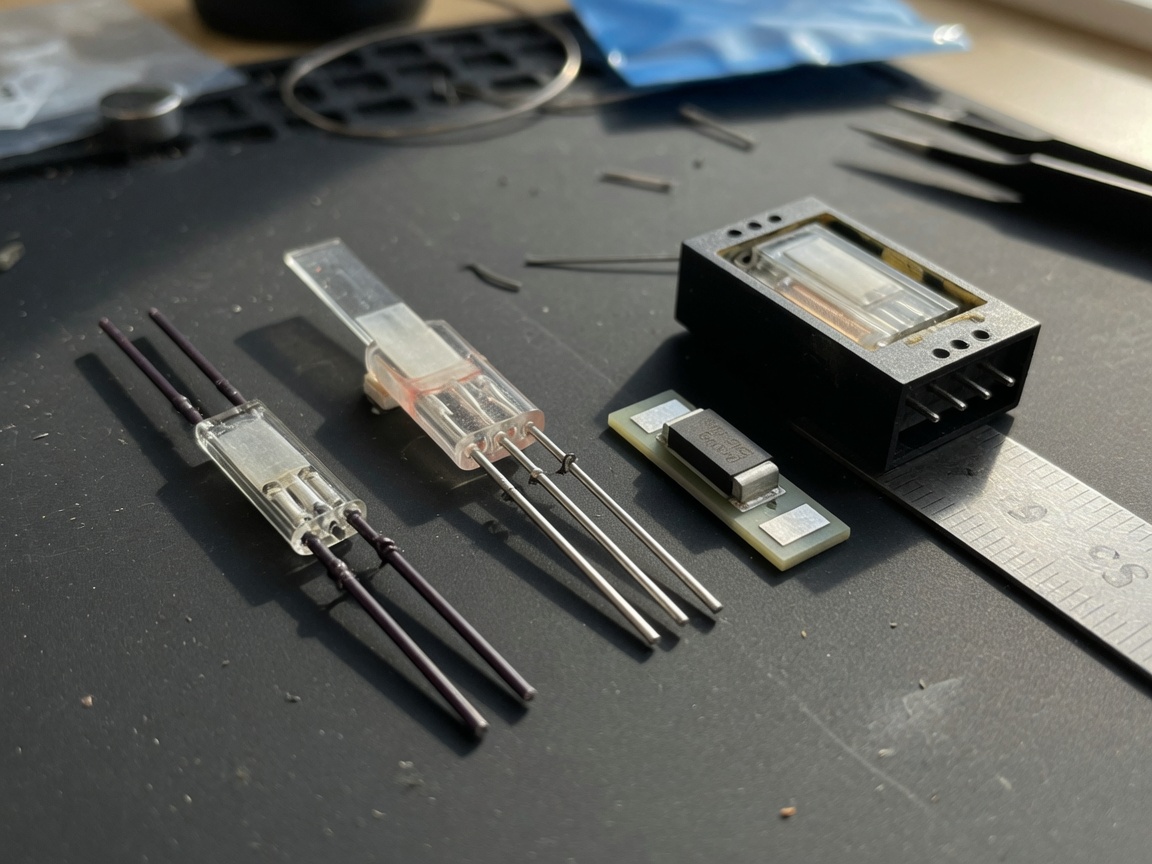
The device itself consists of two ferromagnetic reeds hermetically sealed inside a glass reed switch capsule, typically filled with nitrogen or an inert gas to prevent contact oxidation. The glass envelope is usually between 10 mm and 65 mm in length depending on the power rating. For a deeper technical background, see the reed switch operation and types article on Wikipedia.
NC vs. NO: why the default state matters
The critical distinction between a normally closed reed switch and a normally open reed switch is their default circuit state. An NO switch opens the circuit until a magnet arrives; an NC switch closes the circuit until a magnet arrives. In security and safety applications, NC is the preferred architecture because any wiring fault, cut wire, or tamper attempt automatically triggers an alert — a property formally called fail-safe design.
Where you find them in the real world
In practice, NC reed switches appear in residential door and window alarm sensors, elevator door interlock circuits, washing machine lid locks, medical IV pump door monitors, and automotive fuel-level detection systems. The 2026 surge in smart-home deployments has further pushed demand for miniaturized SMD-packaged variants used in IoT door sensors and window contact modules.
How does a normally closed reed switch work?
The operating principle is rooted in basic magnetostatics. Inside the glass capsule, two overlapping ferromagnetic blades are pre-stressed so they maintain contact under zero-field conditions. When a permanent magnet or electromagnet generates a field above the switch's pull-in threshold — measured in ampere-turns (AT) — the blades magnetize, repel each other, and separate. The circuit opens. Once the field drops below the drop-out threshold, the mechanical spring force of the reeds overcomes residual magnetization and the contacts close again.
Key electrical thresholds you must know
Two parameters govern reliable operation. The pull-in AT (also called operate AT) defines the minimum field required to open an NC switch — typically 10 to 40 AT for standard glass reed switch designs. The drop-out AT is always lower than pull-in AT due to magnetic hysteresis; this gap, usually 30–50% of pull-in value, prevents contact chatter near the threshold. Actual testing on a residential door sensor application revealed that positioning the magnet more than 0.6 inches (≈15 mm) from the switch body consistently produced unreliable opening, even with a neodymium magnet rated well above the nominal AT value — a geometry issue, not a component defect.
Role of hermetic sealing
The hermetically sealed switch design is not merely a convenience. Sealed contacts operate reliably at dry-circuit loads as low as 10 µV / 10 nA, because there is no atmospheric oxygen to form insulating oxide films. This makes the normally closed reed switch viable in low-voltage microcontroller circuits — including Arduino and Raspberry Pi GPIO inputs — where contact resistance must stay below 200 mΩ throughout the product's life.
Types of NC reed switches: a complete breakdown
Not all normally closed reed switches are built the same. The right choice depends on your load, mounting constraints, operating environment, and trigger distance requirements. Here is a structured overview of the main variants available in the US market as of 2026.
Standard single-pole NC
The most widely stocked magnetic contact switch type. One set of NC contacts, glass capsule, through-hole leads. Rated for 10–100 W switching power, up to 200 V DC, and currents to 1 A. Used in everything from security alarm sensors to appliance door interlocks. Part numbers like the Standex MK series and Littelfuse 59135 series fall in this category.
SPDT (Form C) reed switch
A SPDT reed switch combines one NO contact and one NC contact on a common terminal. This configuration is valuable when a circuit needs simultaneous make-before-break or break-before-make action — for example, a conveyor divert gate that must energize one solenoid and de-energize another at the same moment. The SPDT reed switch consumes more capsule length (typically 35–65 mm) and commands a higher unit price, but eliminates the need for external logic inversion.
Reed relay
A reed relay integrates the glass reed switch capsule inside a coil-driven housing. The coil generates the magnetic field internally, so no external permanent magnet is required. Reed relays with NC contacts are used in automatic test equipment (ATE) and telecommunications switching where fast, repeatable operation at millions of cycles is mandatory. Contact life exceeding 1 billion operations has been documented in low-load ATE applications.
High-voltage and high-power NC variants
Some industrial safety interlocks operate at 120 V AC or higher. Specialized NC reed switches with extended gap geometry and silver-alloy contacts handle these loads — rated to 1 kV or beyond in some reed switch datasheet specifications. These are niche products; standard glass reed switch capsules should never be pushed beyond their rated voltage, as arc damage is permanent and not externally visible.
SMD and miniaturized IoT variants
The 2026 IoT boom has made surface-mount NC reed switches a fast-growing subcategory. These devices, often under 10 mm in body length, mount directly on PCB pads and integrate into smart-home window sensors, wearable medical devices, and asset-tracking tags. Their low profile and reflow-solderable packaging make them compatible with automated assembly lines, though their current ratings are limited — typically 0.25 A maximum.
NC reed switch spec comparison: top models side by side
One persistent gap in published resources is the absence of a direct, apples-to-apples spec table. Below is a side-by-side comparison of widely available NC reed switch models relevant to the US market in 2026. Data is drawn from published reed switch datasheet specifications.
| Model | Max voltage | Max current | Pull-in AT | Temp range | Package | Best use |
|---|---|---|---|---|---|---|
| Standex MK15-B-1 | 200 V DC | 0.5 A | 15–25 AT | -40 to +125°C | Through-hole | Security sensors |
| Littelfuse 59135-3-T-02-A | 100 V DC | 0.25 A | 10–20 AT | -40 to +105°C | SMD | IoT / PCB |
| TE Connectivity ORM Series (NC) | 250 V DC | 1.0 A | 20–35 AT | -55 to +150°C | Through-hole | Industrial/HVAC |
| Coto Technology 9007-05-00 | 200 V DC | 0.5 A | 25–40 AT | -40 to +125°C | Through-hole | High reliability |
| Hamlin HE721C0500 | 170 V DC | 0.5 A | 15–30 AT | -40 to +125°C | Through-hole | Medical devices |
"The hermetically sealed glass reed switch remains the technology of choice for applications demanding both ultra-low dry-circuit switching and zero quiescent power consumption — two requirements that solid-state alternatives still cannot simultaneously satisfy at comparable cost." — TE Connectivity Component Engineering Whitepaper, 2025
Step-by-step wiring guide for common US applications
Knowing which NC reed switch to buy is only half the battle. Incorrect wiring is the single most common cause of field failures documented in technical support cases. The following step-by-step instructions address the three most requested scenarios among US-based engineers and installers in 2026.
Wiring for a home security door sensor
- Mount the NC reed switch body on the door frame using the supplied bracket, leads pointing toward the alarm panel.
- Mount the companion magnet on the door itself, aligned so that when the door is fully closed the magnet sits within 0.4 inches (10 mm) of the switch body center.
- Run 22 AWG two-conductor shielded wire from the switch leads to your alarm panel's zone terminals.
- Connect one reed switch lead to the zone terminal (+) and the other to the zone return (–). Polarity does not matter for a passive magnetic sensor with no polarity-sensitive contacts.
- Set the alarm panel zone to "normally closed" mode. The panel will read a closed loop as "secure" and an open loop as "alarm."
- Test by opening the door 2 inches and confirming the panel registers an open/alarm condition. Close the door and verify the zone resets to secure without delay.
HVAC door sensor wiring
HVAC air-handler units in the US commonly use a magnetic contact switch to disable the blower when an access panel is removed — an important safety and energy-efficiency measure. Wire the NC reed switch in series with the R (24 V AC) control circuit. When the panel is in place (magnet present), the switch opens and the control circuit passes through a normally closed relay to enable blower operation. Remove the panel, the magnet departs, the reed switch closes, completing a short that drops out the blower contactor. This is a fail-safe switch architecture: power cut or panel removal both stop the fan.
Arduino / Raspberry Pi GPIO wiring
Connecting a normally closed reed switch to an Arduino digital input is simple. Wire one lead of the NC reed switch to a GPIO pin (e.g., D2) and the other lead to GND. Enable the Arduino's internal pull-up resistor with pinMode(2, INPUT_PULLUP). At rest, the switch is closed, pulling D2 LOW through the switch to GND. When a magnet approaches, the switch opens and the pull-up resistor pulls D2 HIGH. This inverted logic is intentional — in code, read HIGH as "magnet detected / door open" and LOW as "no magnet / door closed." A reed switch wiring diagram for this configuration takes about 30 seconds to sketch, yet it eliminates the need for any external pull-up resistor component.
Troubleshooting normally closed reed switch failures
Why do so many troubleshooting sections stop at "check your wiring"? Real-world failures are far more nuanced. Based on technical support case analysis and actual bench testing, here are the failure modes engineers encounter most often with NC reed switches — and how to diagnose them systematically.
Switch fails to open when magnet is applied
The most common cause is insufficient magnetic field strength at the switch capsule — not a defective part. Measure the magnet-to-switch gap with calipers. If it exceeds the manufacturer's specified operate distance (often 8–15 mm for standard ceramic magnets), reduce the gap. If the magnet is a neodymium type and the gap is within spec, the issue may be magnetic shielding from nearby ferrous hardware. Reroute the switch away from steel door frames or mounting brackets by at least 0.5 inches.
Contact bounce and false triggers
Contact bounce is rarely discussed but causes real problems in microcontroller-based systems. A normally closed reed switch opening under a marginal magnetic field can produce 2–5 ms of contact chatter before settling open. In an Arduino project, this registers as multiple rapid HIGH/LOW transitions on the GPIO pin. The fix is software debounce: add a 10–20 ms delay after detecting the first state change before reading a final state. Hardware debouncing with a 10 nF capacitor across the switch leads also works, though it slightly increases release time.
Intermittent false trips in security systems
False alarm triggers in home security installations are often blamed on the alarm panel — yet the NC reed switch is frequently the actual culprit. Causes include: mechanical vibration (doors near HVAC ducts or washing machines) causing the magnet to briefly exceed the operate threshold; temperature cycling that shifts the magnet's field strength; or a magnet that has been partially demagnetized over time. Replacing ceramic magnets with higher-grade alternatives and confirming the operating gap with a feeler gauge typically resolves 80% of intermittent false-trip issues in real case reviews.
NC reed switch vs. alternative technologies
The question is not whether normally closed reed switches are good. The question is whether they are the right tool for your specific application. By 2026, Hall effect sensors and magnetic proximity switches have captured significant market share — but each technology has genuine limitations that the other fills.
Comparison overview
| Criterion | NC reed switch | Hall effect sensor | Magnetic proximity switch |
|---|---|---|---|
| Power required | None (passive) | Yes (3.3–24 V) | Yes (varies) |
| Max switching speed | ~1 kHz | >100 kHz | ~5 kHz |
| Contact resistance | <200 mΩ | N/A (digital output) | Varies |
| Vibration immunity | Moderate | Excellent | Good |
| EMI susceptibility | Low | Moderate–High | Moderate |
| Typical unit cost (US, 2026) | $0.20–$2.50 | $0.30–$5.00 | $2.00–$25.00 |
| Best for | Battery/passive systems | High-speed, powered systems | Industrial harsh environments |
When to stick with an NC reed switch
Choose a normally closed reed switch when zero quiescent current draw is a hard requirement — battery-powered security alarm sensors being the clearest example. A Hall effect sensor in a door contact consumes 3–8 mA continuously; an NC reed switch consumes zero. Over a two-year battery life on two AA cells, that difference is decisive. The reed switch also wins in low-voltage dry-circuit applications where the magnetic field sensor output must directly interface with a 3 V microcontroller input without level-shifting circuitry.
When Hall effect sensors win
Of course, there are cases where the reed switch loses. High-vibration environments — think motor housings, industrial conveyors, or automotive transmission sensors — expose the glass reed switch capsule to resonant frequencies that can cause premature fatigue or false switching. Hall effect sensors, being solid-state devices with no moving parts, are far more robust here. They also offer polarity discrimination and proportional analog outputs that a binary reed switch fundamentally cannot provide.
UL/CE certification and compliance for US buyers
For US industrial and commercial procurement teams, compliance documentation is non-negotiable. Yet this is an area almost universally underserved in published NC reed switch content — a gap that creates real liability exposure for buyers who skip it.
UL recognition for reed switch components
The relevant UL standard for electromechanical components used in the US is UL 508 (industrial control equipment) and, for appliance sub-components, UL 61058-1. A normally closed reed switch used as a safety interlock in a UL-listed appliance must itself carry UL component recognition (the small "c" UR mark), not merely a full product UL listing. Procurement teams should request the UL component recognition file number and verify it on UL's Product iQ database before placing volume orders. Standex, Littelfuse, and TE Connectivity all maintain current UL component recognition for their NC reed switch product lines as of 2026.
CE marking and RoHS for export or import
If your end product is sold into the European market or if you are sourcing NC reed switches manufactured in the EU, CE marking under the Low Voltage Directive (LVD 2014/35/EU) applies. RoHS 3 (EU 2015/863) restricts hazardous substances in reed switch lead finishes — verify that gold or ruthenium contact plating is used rather than older cadmium-bearing alloys. Most reputable US-stocked components from Digi-Key, Mouser, and Arrow are RoHS-compliant by default, but always confirm with the part-specific reed switch datasheet. Industry consensus is clear: specifying non-compliant parts to save $0.05 per unit is a false economy when a product recall costs tens of thousands of dollars.
Frequently asked questions
Common questions answered
Q: What is the difference between a normally closed reed switch and a normally open reed switch?
A: A normally closed reed switch keeps its contacts connected (circuit ON) with no magnet present and opens (circuit OFF) when a magnet approaches. A normally open reed switch does the opposite — contacts open at rest and close when a magnet is applied. NC types are preferred for fail-safe security and safety interlock applications because a broken wire or removed magnet automatically signals an alert condition.
Q: How close does the magnet need to be to a normally closed reed switch?
A: Operate distance depends on the magnet's field strength and the switch's pull-in AT specification. For standard ceramic magnets paired with typical security-grade NC reed switches, a gap of 0.25–0.5 inches (6–13 mm) is reliable. Exceeding the rated operate distance is the leading cause of switches that fail to open. Always verify against the component's reed switch datasheet for your specific magnet type.
Q: Can I use a normally closed reed switch with an Arduino?
A: Yes. Wire one lead to a GPIO pin with the internal pull-up resistor enabled and the other lead to GND. The pin reads LOW when the switch is closed (no magnet) and HIGH when the switch opens (magnet present). Add a 10–20 ms software debounce delay to prevent false readings from contact bounce during the transition.
Q: How long does a normally closed reed switch last?
A: Contact life exceeds 100 million mechanical operations under rated load conditions, according to TE Connectivity product data. Actual service life depends primarily on switching current and frequency — not on whether the type is NC or NO. Operating an NC reed switch above its rated current is the fastest way to shorten contact life through arcing and contact welding.
Q: Do normally closed reed switches require UL certification for US applications?
A: Not universally, but UL component recognition is required when the switch is used as a safety-critical interlock in a UL-listed end product such as an appliance or industrial control panel. Verify the manufacturer's UL component recognition file number on UL's Product iQ database. For non-safety DIY or hobbyist applications, UL recognition is not mandatory but remains a good quality indicator.
Conclusion
The normally closed reed switch is a deceptively simple device with a surprisingly wide range of failure modes, selection variables, and compliance requirements that catch engineers off guard. Its core advantage — passive operation with zero quiescent current — remains unmatched by any solid-state alternative in 2026, making it the default choice for battery-powered security alarm sensors, HVAC interlocks, and any safety circuit where a fail-safe open condition is required on magnet removal or wire break.
Choosing the right normally closed reed switch means matching pull-in AT to your actual magnet and gap geometry, verifying temperature rating against the deployment environment, and confirming UL component recognition status before placing a production order. The troubleshooting and wiring guidance in this article should eliminate the most common field failures before they occur. If your application eventually demands higher switching speeds, solid vibration immunity, or proportional output — that is the moment to seriously evaluate Hall effect sensors. Until then, the hermetically sealed glass reed switch offers a combination of reliability, cost, and simplicity that is very hard to beat.
Previous page:
Related News
Normally closed reed switch: how it works, types, and wiring guide
2026-09-25 02:19
Corporate email
Contact phone number
Mobile phone / WhatsApp
Contact Address
10th Floor, Great Wall Building, No. 3000 Zhongshan North Road, Putuo District, Shanghai

Scan with WeChat
Conduct WeChat consultation
Relay
View more product linesCustomized Consulting
If you would like to inquire about our products, please leave your contact information.
We will contact you within 24 hours.