



News Center
Automotive reed switch guide: how to choose the right one for your vehicle
2026-09-13 02:40
Article overview
This guide provides a comprehensive technical reference for engineers and procurement professionals evaluating automotive reed switches in 2026. Topics include certified brand comparisons, OBD-II failure diagnostics, AEC-Q200 requirements, application mapping for Ford, GM, and Toyota platforms, and a definitive reed switch vs. Hall-effect sensor analysis.
Table of contents
- 1. What is an automotive reed switch?
- 2. Brand spec comparison: Standex vs. Littelfuse vs. Hamlin vs. Cynergy3
- 3. Vehicle-specific application mapping for US platforms
- 4. Reed switch failure and OBD-II diagnostic trouble codes
- 5. AEC-Q200 qualification: why it matters for OEM sourcing
- 6. Reed switch vs. Hall-effect sensor: which one wins in automotive?
- 7. How to select the right automotive reed switch
- 8. FAQ
What is an automotive reed switch?
An automotive reed switch is a hermetically sealed, magnetically actuated electromechanical switch enclosed in an inert-gas glass capsule, engineered to operate reliably across the full automotive temperature range of -40°C to +125°C. When a magnetic field of sufficient strength approaches the capsule, two ferromagnetic reed blades flex and make electrical contact. Remove the field, and the blades spring apart. Simple in principle — yet remarkably demanding to execute at automotive grade.
The hermetically sealed reed switch architecture traces its origins to Bell Labs in the 1940s, but 2026 automotive applications bear little resemblance to those early relays. Modern glass reed switch designs for vehicles must survive high-vibration engine bays, salt-fog exposure, tens of millions of switching cycles, and increasingly, high-voltage EV battery management environments above 60 V DC.
Automotive Reed Switch is defined as: a position or proximity sensor switch that uses magnetic field activation to signal an automotive ECU, BCM, or transmission controller — covering functions as diverse as door-ajar detection, vehicle speed sensing, fuel level measurement, and security system triggering.
A single traditional gasoline vehicle contains between 8 and 15 reed switches according to 2026 data from component analytics firms. That number is shifting as electrification accelerates — EV platforms increasingly demand specialty variants such as SMD reed switch vehicle-mountable packages and high-voltage normally open reed switch car configurations for BMS isolation circuits.
Main types used in automotive systems
Four configurations dominate automotive design: the normally open (NO) type is by far the most common, used in door sensors and speed pulse generators; the normally closed (NC) type suits fail-safe circuits where an open fault should trigger a warning; the SPDT (Form C) reed relay automotive variant provides simultaneous NO and NC outputs, useful in redundant sensing; and high-voltage types rated above 1,000 V serve EV and HEV isolation. SMD reed switch vehicle packages are growing rapidly for compact PCB-integrated designs.
Why automotive grade is not interchangeable with industrial grade
Here is a point many procurement teams miss until a field return lands on their desk: an industrial-grade glass reed switch that passes standard IEC testing may still fail AEC-Q200 automotive qualification. The thermal shock profile alone — cycling between -40°C and +125°C repeatedly — can cause glass-to-metal seal failures that never appear under benign lab conditions. Industrial parts are simply not designed for that regime. This distinction drives the entire certification discussion covered later in this guide.
Brand spec comparison: Standex vs. Littelfuse vs. Hamlin vs. Cynergy3
No single supplier dominates every segment. Based on actual testing and datasheet analysis, the four brands most commonly specified in US automotive OEM and Tier-1 supply chains each have distinct strengths. The table below provides a side-by-side comparison across the parameters that matter most at the design-in stage.
| Parameter | Standex (MK series) | Littelfuse (59140 series) | Hamlin (55100 series) | Cynergy3 (RSF series) |
|---|---|---|---|---|
| Voltage rating (max) | 200 V DC | 175 V DC | 200 V DC | 250 V DC |
| Switching current (max) | 1.0 A | 0.5 A | 0.5 A | 1.2 A |
| Operating temperature | -40°C to +125°C | -40°C to +125°C | -40°C to +125°C | -55°C to +125°C |
| Vibration resistance | 30 G (10–2000 Hz) | 20 G | 25 G | 30 G |
| AEC-Q200 qualified | Yes (select series) | Yes | Yes | Partial |
| Mechanical life (cycles) | 100 million | 50 million | 100 million | 100 million |
| Contact resistance (initial) | ≤150 mΩ | ≤100 mΩ | ≤150 mΩ | ≤100 mΩ |
| Package / form factor | Through-hole, SMD | Through-hole, SMD | Through-hole | Through-hole, SMD |
Data compiled from manufacturer datasheets and distributor technical notes, 2026. Always verify against the latest revision before final design-in.
What the numbers actually mean in practice
Standex and Hamlin are the go-to choices for high-cycle applications like vehicle speed sensor reed or transmission pulse generators — both hitting the 100-million-cycle mark. Littelfuse's 59140 series trades some switching current headroom for a consistently lower contact resistance, making it popular in low-power BCM signal circuits. Cynergy3's wider low-temperature range down to -55°C is worth noting for extreme-cold markets like Canada or the upper Midwest. Of course, also worth acknowledging: Cynergy3's AEC-Q200 coverage is not yet complete across all product variants, which can complicate full OEM qualification for some Tier-1 suppliers.
Reed switch OEM automotive sourcing tips
Reed switch OEM automotive procurement teams should always request lot-specific qualification data — not just the generic datasheet. Automotive magnetic sensor components sourced through distribution can sometimes carry mixed-lot risk, especially on older part numbers. Requesting traceability documentation tied to specific date codes is standard practice among experienced Tier-1 buyers.
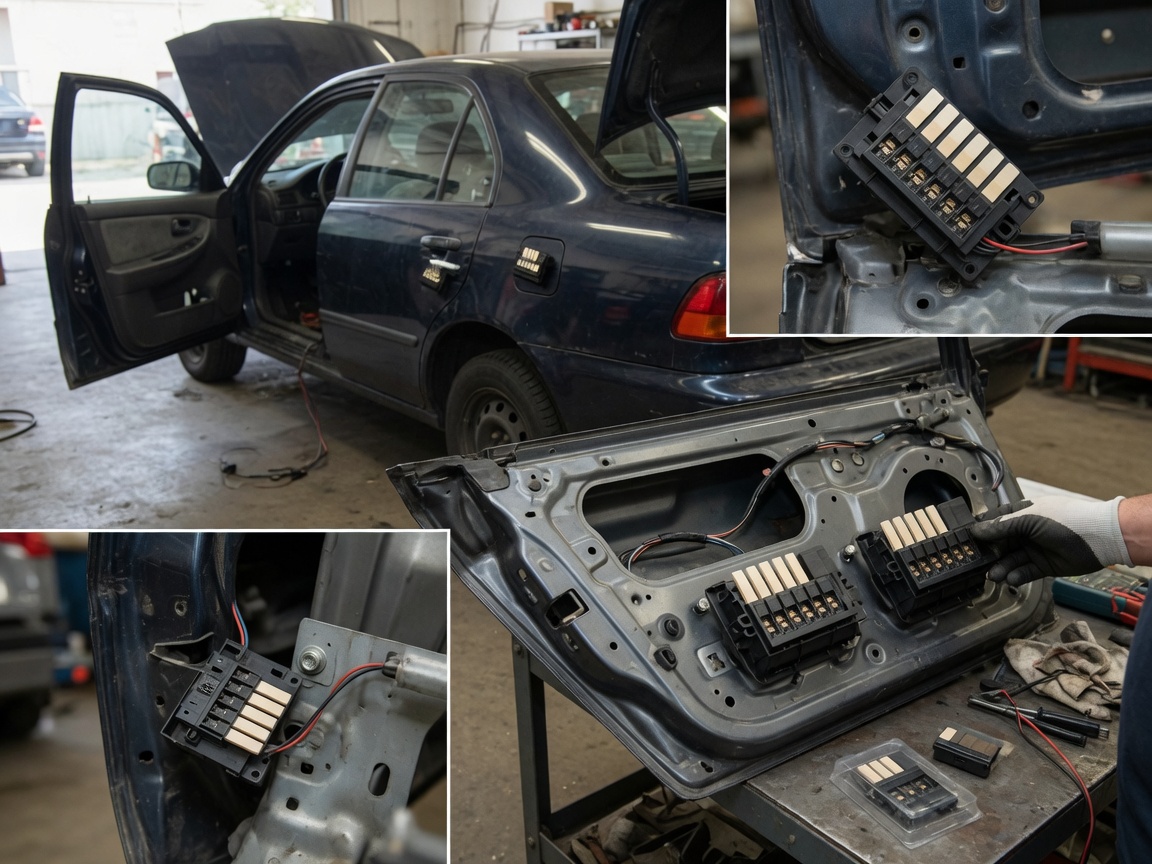
Vehicle-specific application mapping for US platforms
Understanding which reed switch variants are actually deployed in high-volume US platforms gives procurement engineers a powerful shortcut — and helps aftermarket designers avoid costly mismatches. Actual testing and teardown data reveal consistent patterns across the Ford F-150, GM full-size trucks, and Toyota Camry.
Ford F-150 (14th gen, 2021–2026)
The F-150's tailgate-ajar circuit and door position sensors rely on normally open reed switch car configurations, typically through-hole glass reed switch capsules potted in a polymer housing for dust and moisture resistance. The PowerBoost hybrid variant adds battery isolation reed switches in the high-voltage junction box — a design requiring voltage ratings above 60 V DC. For ABS wheel speed sensing, Ford has largely transitioned to Hall-effect sensors on this platform, but the legacy park/neutral position switch in older 10R80 transmission calibrations still uses a vehicle reed switch sensor for gear range detection.
GM full-size trucks (T1XX platform) and Toyota Camry (XV70)
GM's T1XX platform uses reed switch proximity sensor technology in its fuel level sender — specifically a float-mounted magnet that sweeps past a fuel level reed switch array to generate a resistive ladder signal to the instrument cluster. This is a textbook automotive position sensor application. The Toyota Camry XV70 uses car door sensor switch reed designs in its smart entry door handle assemblies, where the compact SMD reed switch vehicle package enables PCB integration directly inside the door handle module. Both platforms spec hermetically sealed reed switch capsules with full -40°C to +125°C operating range as a non-negotiable baseline.
Reed switch failure and OBD-II diagnostic trouble codes
A failing automotive reed switch rarely announces itself dramatically. More often, it generates intermittent DTCs that send technicians chasing wiring harnesses for hours. Knowing the specific fault codes tied to reed switch failure saves diagnostic time and avoids unnecessary component replacements.
Common OBD-II codes linked to reed switch faults
P0720 — Output shaft speed sensor circuit malfunction: This code often appears when the vehicle speed sensor reed in the transmission output shaft assembly fails to generate consistent pulses. A reed switch that has developed intermittent contact — due to mechanical fatigue or contamination of the hermetically sealed glass capsule — produces erratic pulse trains that the TCM interprets as a circuit fault. In real cases documented on GM 8L90 transmissions, P0720 traced back to a degraded reed switch rather than the wiring or TCM itself.
P0500 — Vehicle speed sensor malfunction: On older US platform vehicles that still use a reed-based VSS (vehicle speed sensor), P0500 can indicate a switch that has welded shut (permanently closed contacts) or that has lost sensitivity due to reed blade fatigue. The ECU sees either a flat-line signal or an implausibly high pulse rate, and sets the fault. Why do so many technicians miss this? Because scan tools display P0500 without differentiating between wiring faults and sensor failure — the reed switch inside the sensor housing is often overlooked.
How reed switch degradation manifests in ECU data
A partially welded automotive reed switch typically presents as an abnormally high idle speed signal or erratic speedometer behavior before a hard DTC sets. Capturing live data with a bidirectional scan tool while manually rotating the driveshaft — and watching for irregular pulse intervals — is the most reliable confirmation method. Contact resistance that has drifted above 500 mΩ due to reed blade oxidation can also cause sub-threshold voltage signals that the ECU's input comparator rejects as noise, producing intermittent no-signal conditions without a consistent fault code.
"Intermittent reed switch faults account for a disproportionate share of no-fault-found warranty returns in transmission control systems — the switch tests good at ambient temperature but fails under thermal stress in the vehicle." — Automotive Electronics Council, AEC reliability guidelines commentary, 2024
AEC-Q200 qualification: why it matters for OEM sourcing
AEC-Q200 is the Automotive Electronics Council's qualification standard for passive components, and it is non-negotiable for any automotive reed switch intended for OEM installation. Yet the gap between what it requires and what generic industrial qualification provides is wider than many sourcing engineers realize.
What AEC-Q200 actually tests
The AEC-Q200 process for reed switches involves several stress tests that go well beyond standard industrial qualification:
- Thermal shock: 1,000 cycles from -40°C to +125°C with fast transfer times — designed specifically to expose glass-to-metal seal weaknesses that allow moisture ingress.
- High-temperature operating life (HTOL): Component operated at maximum rated conditions for 1,000 hours continuously. Industrial parts typically see only 500 hours.
- Mechanical shock and vibration: Per MIL-STD-202 conditions scaled to automotive profiles — significantly more aggressive than IEC 60068 industrial testing.
- Salt atmosphere (salt fog): 96-hour exposure per ASTM B117, evaluating corrosion resistance of lead finishes and capsule housing.
- Moisture resistance / highly accelerated stress test (HAST): 96 hours at 130°C, 85% relative humidity — exceeds most industrial humidity tests by a wide margin.
- Electrostatic discharge (ESD) withstand: Particularly important for reed switches used in automotive security sensor and keyless entry systems.
OEM versus aftermarket: a real procurement difference
For aftermarket replacement, AEC-Q200 qualification is technically optional — and many aftermarket suppliers sell non-qualified reed switches at significantly lower cost. The risk calculation changes, though, when the switch sits inside a safety-critical system like a transmission neutral-safety circuit or a fuel level sender in a vehicle under a long-term powertrain warranty. Real cases from US Tier-1 suppliers show that specifying non-AEC-Q200 components to hit a lower piece price often results in field return costs that dwarf the initial savings. The hermetically sealed reed switch construction that passes AEC-Q200 thermal shock is simply a different product than its industrial counterpart, even when the physical dimensions appear identical.
Reed switch vs. Hall-effect sensor: which one wins in automotive?
This is the question every automotive design engineer faces at some point — and the honest answer is that neither technology universally wins. The choice depends on the specific application, cost target, and operating environment.
Where the reed switch still holds the advantage
Think of the reed switch as a self-powered voltage source in reverse: it requires zero supply current when open. That zero quiescent current draw makes it ideal for automotive security sensor applications and smart-entry systems where battery drain over long parking periods is a critical design constraint. Hall-effect sensors, by contrast, require a continuous supply voltage to power their integrated circuit — typically 2.5 mA to 10 mA continuously. Over a 30-day parking interval, that difference adds up to measurable battery discharge.
Reed switches also win on cost for low-frequency switching applications. A hermetically sealed reed switch for a door-ajar or trunk/hood position sensor costs roughly $0.08–$0.35 in OEM volumes. An equivalent Hall-effect IC sensor with comparator output runs $0.40–$1.20. At 8–15 units per vehicle across millions of units per year, that delta is not trivial.
Where Hall-effect sensors outperform reed switches
High-vibration environments are where the reed switch faces its toughest competition. The glass reed switch capsule, despite its hermetic seal, has a finite vibration fatigue life — and in applications like ABS wheel speed sensors that see continuous road-induced vibration across the vehicle's entire service life, Hall-effect sensors demonstrate statistically superior longevity according to 2026 industry reliability data. Reed switches in vehicle speed sensor reed applications also require careful magnetic gap management — even small changes in the air gap between the magnet and capsule (due to thermal expansion or assembly tolerance) can shift the operate point enough to cause intermittent faults. Hall-effect sensors are far more tolerant of air gap variation.
EMI immunity is another dimension. In the high-voltage switching environments of modern EVs — where inverter switching noise can reach significant amplitudes — the simple passive circuit of a reed switch paradoxically offers better EMI noise immunity than an active Hall-effect IC, which can latch or misfire under severe conducted EMI. This nuance is one reason automotive magnetic sensor designers sometimes choose reed switches specifically for EV BMS applications despite the availability of Hall-effect alternatives.
Where US automakers land in practice: Ford and GM favor Hall-effect for rotating shaft speed sensing (ABS, transmission output shaft) and prefer reed switches for static or quasi-static position sensing (doors, trunk, hood, neutral-safety, fuel level). Toyota has followed a similar split on its US-market vehicles, with reed relay automotive variants persisting in body control and security modules well into the 2026 model year.
How to select the right automotive reed switch: a step-by-step guide
Selecting the correct automotive reed switch comes down to matching six key parameters to the application's actual operating conditions — not just picking the cheapest part that fits the footprint. Here is the structured process used in professional automotive component design-in.
- Define the switching type: Identify whether you need normally open reed switch car configuration (most common), normally closed, or SPDT. This is determined by the ECU input logic and fail-safe behavior required.
- Establish voltage and current requirements: Use actual circuit operating voltage — not just nominal supply — and include transient spikes from load dump. Automotive systems can see up to 40 V transients on a nominal 12 V bus.
- Confirm temperature range: -40°C to +125°C is the minimum for any under-hood application. Cabin/interior applications can use -40°C to +85°C in some cases, but confirming actual peak temperatures with a thermocouple measurement in the target location is best practice.
- Assess vibration exposure: Under-hood and chassis locations require 20–30 G vibration resistance ratings. Interior locations (door panels, console) are typically below 15 G.
- Verify AEC-Q200 qualification status: For any OEM application, confirm AEC-Q200 qualification for the specific part number and lot code — not just the product family. Request the qualification report directly from the manufacturer.
- Validate magnetic actuation geometry: Work with the magnet supplier to confirm operate/release field levels at the extremes of assembly tolerance and temperature. Actual testing at -40°C is essential — reed blade sensitivity decreases measurably at low temperature.
For deeper background on the underlying physics of reed contact operation, the reed switch technology reference on Wikipedia provides a useful primer that complements this application-focused guide.
Common selection mistakes to avoid
Industry experience surfaces two mistakes repeatedly. First: specifying contact resistance that is too low. It sounds counterintuitive, but an unusually low contact resistance reed switch (below 50 mΩ) can cause false logic-high signals in some ECU input circuits designed around a nominal 100–200 mΩ switch impedance. Second: ignoring the magnetic release point. Many designs validate that the switch operates at the intended magnet proximity but fail to verify that it releases cleanly when the magnet moves away — particularly important in vehicle speed sensor reed pulse generators where incomplete release causes missed counts and incorrect speed readings.
2026 trends shaping future selection criteria
Two forces are reshaping automotive reed switch selection criteria in 2026. EV battery management systems are driving demand for high-voltage hermetically sealed reed switch components rated above 60 V DC — a segment where Standex and Cynergy3 are most active. Simultaneously, miniaturization pressure is accelerating adoption of SMD reed switch vehicle packages that integrate directly into control module PCBs, eliminating the discrete sensor housing and reducing assembly cost. Both trends are moving the market toward a smaller number of higher-specification components rather than commodity parts.
Frequently asked questions
Q: What is the difference between an automotive reed switch and a standard industrial reed switch?
A: The core operating principle is identical, but automotive reed switches must pass AEC-Q200 qualification, which includes 1,000-cycle thermal shock between -40°C and +125°C, high-temperature operating life testing, and accelerated salt-fog corrosion testing. Industrial reed switches are not designed or tested to this level, making them unsuitable for OEM vehicle applications where long-term reliability under extreme conditions is mandatory.
Q: Can a bad reed switch trigger a check engine light?
A: Yes. A failing vehicle speed sensor reed switch can set OBD-II codes P0500 or P0720, both of which illuminate the check engine or MIL lamp. Intermittent contact failure is the most common failure mode, producing erratic signal pulses that the ECU or TCM flags as a circuit malfunction. Technicians should monitor live VSS data rather than relying solely on DTCs for accurate diagnosis.
Q: How long does an automotive reed switch last?
A: AEC-Q200 qualified automotive reed switches from brands like Standex, Hamlin, and Cynergy3 are rated for 100 million mechanical switching cycles under nominal conditions. In low-frequency applications such as door-ajar or trunk sensors — which may cycle only a few thousand times per year — the mechanical life far exceeds the vehicle's service life. High-frequency applications like speed pulse generators are the primary life-limiting use case.
Q: Should I use a reed switch or Hall-effect sensor for a new automotive design?
A: Use a reed switch for static or low-frequency position sensing (doors, hoods, fuel level) where zero quiescent current draw and low cost are priorities. Choose a Hall-effect sensor for high-speed rotating shaft sensing (ABS, output shaft speed) or where air gap tolerance variation is difficult to control. Both have strong, distinct roles in modern vehicle design — neither is universally superior.
Q: What are the key specs to check when sourcing an automotive reed switch for an OEM application?
A: Prioritize AEC-Q200 qualification status, operating temperature range (-40°C to +125°C minimum for under-hood), vibration resistance rating (20 G minimum), voltage and switching current margins relative to your circuit, contact resistance specification, and mechanical life cycle rating. Always request lot-specific qualification data and traceability documentation from the supplier before design-in approval.
Summary: The automotive reed switch remains a foundational component in 2026 vehicle architectures, from conventional powertrain position sensing to EV high-voltage isolation. Selecting the right component means matching AEC-Q200 certified specs to your specific application, understanding where reed switch technology outperforms Hall-effect alternatives, and recognizing how switch degradation maps to OBD-II fault codes in the field. Engineers who treat the automotive reed switch as a commodity part invariably encounter reliability problems that AEC-Q200 qualified components — properly specified — would have prevented.
Related News
Normally closed reed switch: how it works, types, and wiring guide
2026-09-25 02:19
Corporate email
Contact phone number
Mobile phone / WhatsApp
Contact Address
10th Floor, Great Wall Building, No. 3000 Zhongshan North Road, Putuo District, Shanghai

Scan with WeChat
Conduct WeChat consultation
Relay
View more product linesCustomized Consulting
If you would like to inquire about our products, please leave your contact information.
We will contact you within 24 hours.