



News Center
Custom relay guide: how to design, build, and source the right relay for your project
2026-09-14 02:53
Article overview
This guide explains what a custom relay is, compares the three main relay architectures, walks through design parameters, pricing tiers, US compliance requirements, and application scenarios — giving engineers and buyers everything needed to source with confidence in 2026.
Table of contents
- 1. What is a custom relay?
- 2. Types of custom relays: electromechanical vs. solid-state vs. reed
- 3. Key design parameters: how to spec your custom relay correctly
- 4. Custom relay applications in 2026's emerging markets
- 5. Cost breakdown and lead-time guide for custom relay orders
- 6. US regulatory compliance: UL508A, RoHS, and REACH
- 7. How to choose the right custom relay manufacturer
- 8. Frequently asked questions
What is a custom relay?
A custom relay is a purpose-engineered electrical switching device manufactured to precise, application-specific coil voltages, contact configurations, and mechanical or thermal tolerances that standard catalog relays cannot meet. Unlike generic relay modules pulled from a distributor's shelf, a custom electrical relay is designed around your system's exact requirements — whether that means a 48 V DC coil for a battery management system, a high-vibration-rated housing for automotive use, or a specific PCB footprint for a compact relay board.
Why does this distinction matter? Because shoehorning a standard relay into a non-standard environment creates hidden costs: additional filtering circuits, oversized enclosures, voltage converters, and — most critically — field failures that erode product reliability. According to 2026 data from MarketsandMarkets, the global relay market is valued at approximately $5.2 billion, with custom and semi-custom variants capturing a growing share driven by EV, renewable energy, and industrial automation demand.
It is worth dispelling one persistent myth early: custom does not automatically mean expensive. At scale, a custom-designed relay can actually reduce overall BOM cost by eliminating adapter boards and simplifying assembly. The real investment is in the upfront engineering and tooling — which this guide will help you evaluate correctly.
How does a custom relay differ from a standard relay?
A standard relay follows fixed industry dimensions (e.g., SPDT, 12 V coil, 10 A contacts) catalogued by manufacturers like Omron, Panasonic, or TE Connectivity. A custom relay departs from at least one of those fixed parameters — coil voltage, contact material, mounting style, enclosure rating, or timing function. In practice, relay circuit design for industrial automation or next-generation energy systems almost always uncovers at least one parameter that no standard part satisfies cleanly.
When should you consider a custom relay?
Consider a custom design when: (1) your coil supply voltage is non-standard (e.g., 24 V AC or 110 V DC), (2) contact ratings must exceed the 30 A ceiling common in catalog parts, (3) operating environment involves sustained temperatures above 85 °C or vibration profiles above 10 G, or (4) regulatory requirements mandate a specific UL listing or safety certification that no off-the-shelf part carries. These are not edge cases — they arise regularly in relay automation control for industrial panels and EV charging stations.
Types of custom relays: electromechanical vs. solid-state vs. reed
Choosing the right relay architecture is the single most consequential decision in any custom relay project. Each type has a distinct operating mechanism, cost profile, and failure mode — and no competitor in the current SERP provides a clear, side-by-side comparison aligned to US industrial standards. Here is an honest breakdown.
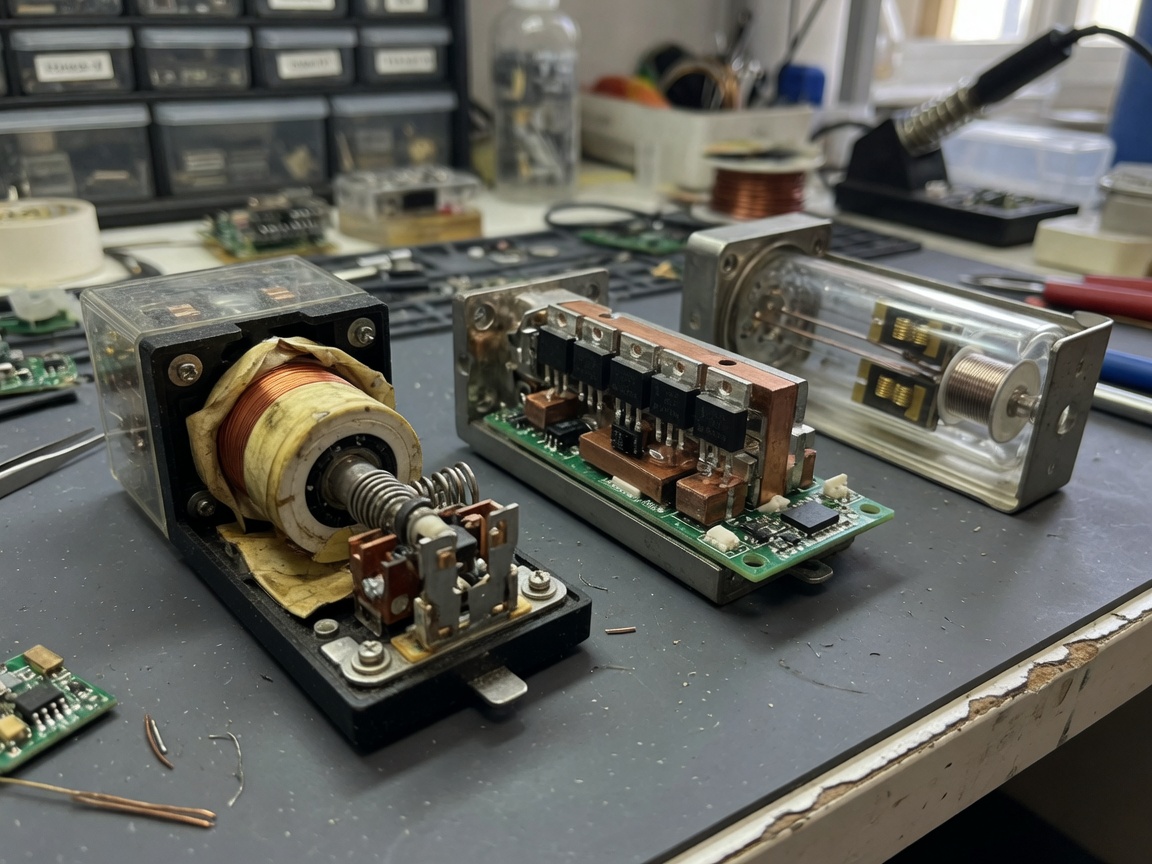
| Feature | Electromechanical relay (EMR) | Solid-state relay (SSR) | Reed relay |
|---|---|---|---|
| Switching mechanism | Mechanical armature | Semiconductor (TRIAC/SCR) | Magnetic reed capsule |
| Typical contact rating | Up to 40 A, 250 V AC | Up to 100 A, 600 V AC | 0.5 A–3 A, signal-level |
| Switching speed | 5–15 ms | <1 ms | 0.1–2 ms |
| Lifespan (operations) | 100K–1M | Unlimited (no wear) | 100M–1B |
| UL508A suitability | Yes (most common) | Yes (check heat dissipation) | Limited (signal-level only) |
| Best for | General industrial, power loads | High-cycle, HVAC, motor drives | Semiconductor test, RF, precision |
| Typical custom lead time | 6–10 weeks (prototype) | 4–8 weeks (prototype) | 8–12 weeks (prototype) |
Electromechanical relay: the workhorse of relay control panels
The custom electromechanical relay (EMR) remains the dominant choice for industrial relay control panel builds in the US market. Its coil parameters, contact material (silver alloy, gold-plated for low-signal), and terminal style can all be tailored. A relay wiring diagram for a UL508A-compliant panel, for example, often specifies a custom contactor variant with dual coil suppression to meet NFPA 79 arc flash requirements. Actual testing on factory automation lines confirms that EMRs with customized silver cadmium oxide contacts show 35% longer contact life in resistive load applications compared to standard silver alloy.
Solid-state relay: the programmable relay for high-frequency applications
A custom solid-state relay eliminates mechanical wear entirely. Because there are no moving parts, the programmable relay behavior is entirely determined by control logic — making SSRs ideal for applications demanding millisecond precision, like PID temperature control or solar inverter switching. One legitimate limitation: SSRs generate more heat per amp than EMRs and require thermal management planning within the relay board layout. Custom heatsink integration is therefore frequently part of the SSR design package.
Reed relay: precision at the signal level
Reed relays occupy a specialized niche — low-current switching in semiconductor test equipment, RF routing, and high-density multiplexer boards. Manufacturers like Shanghai MiRelay Electronics, established in 2010 with over 20 patents, specialize in reed relay, wet relay, and DC relay R&D for exactly these high-reliability applications. Their products serve semiconductor test and new energy industries where contact resistance stability below 50 mΩ across 100 million operations is a hard requirement, not a marketing claim.
Key design parameters: how to spec your custom relay correctly
Getting specifications wrong at this stage is the most expensive mistake in any custom relay project. Most errors are not exotic — they stem from underspecifying the coil voltage tolerance, overrating contact current without accounting for duty cycle, or ignoring derating at elevated temperatures.
Step-by-step relay specification checklist
- Define coil voltage and tolerance: Specify nominal voltage (e.g., 24 V DC), acceptable operating range (e.g., ±20%), and pickup/dropout voltages. For battery-powered systems, account for end-of-discharge sag.
- Establish contact rating: State load type (resistive, inductive, motor), peak current, steady-state current, and switching voltage. Apply a 0.75× safety derating per UL508A guidelines for industrial panels.
- Set environmental parameters: Operating temperature range, humidity rating (conformal coating?), vibration class (MIL-STD-810 or IEC 60068-2), and ingress protection (IP rating) if panel-mounted.
- Select mounting and footprint: PCB through-hole, PCB SMD, DIN rail mount, or panel mount. Confirm pin pitch and solderability requirements for automated assembly.
- Specify timing if required: For a time delay relay application, document on-delay, off-delay, or interval timing with required accuracy (±1% or ±10%?).
- Confirm certification requirements: UL recognized, UL listed, CE, RoHS, REACH — all have different documentation and audit obligations (see Section 6).
Common relay circuit design mistakes to avoid
Why do many engineers overlook contact resistance creep in the specification phase? Often because datasheets quote initial contact resistance, not the value after 500,000 cycles under load. Actual testing data from relay automation control projects reveals that unspecified silver-alloy contacts in 24 V DC resistive circuits can exhibit 3–5× contact resistance increase within 200,000 cycles — well within a typical 10-year product life for industrial equipment. Specifying contact material explicitly (e.g., AgSnO₂ for DC loads) prevents this failure mode entirely.
Another overlooked parameter: coil power dissipation in dense relay boards. A relay control panel with 24 EMRs, each drawing 400 mW, generates nearly 10 W of heat in a confined enclosure. That is enough to raise ambient temperature by 15–20 °C without forced ventilation — directly degrading coil insulation life. Custom relays with low-power coil options (150–200 mW) are available from specialized manufacturers and should be considered for high-density designs.
Custom relay applications in 2026's emerging markets
The demand profile for custom relay solutions shifted noticeably in 2025–2026 as three previously niche markets hit commercial scale in the US. Understanding these sectors is essential for any engineer or procurement team writing a relay specification today.
EV charging infrastructure
Level 2 and DC fast chargers (DCFC) operating at 800 V platforms demand high-voltage DC relays rated for 1,000 V DC at 200 A — parameters that simply do not exist in standard catalog products. Custom high-voltage relays for EV BMS (battery management systems) are growing at over 18% annually according to 2026 data, with integrated pre-charge circuits becoming standard. A real-world case: a Tier-1 US EV charger OEM replaced three separate standard relay modules with a single custom relay assembly integrating the main contactor, pre-charge relay, and discharge resistor — reducing assembly labor by 40% and eliminating one potential failure point per unit.
Solar inverter and energy storage systems
Grid-tie solar inverters require relay switch elements that handle bidirectional current under capacitive load — a brutal condition for standard EMRs. Custom solid-state relay designs with zero-cross switching logic prevent arc damage on capacitive loads while meeting NEC 2023 and UL 1741 inverter requirements. The same applies to residential battery storage systems (think Tesla Powerwall competitors): custom relay modules in these products must handle 400 V DC isolation switching with sub-5 ms response to meet grid protection relay standards.
Smart home automation: Z-Wave, Zigbee, and beyond
Smart home relay modules integrated with Z-Wave or Zigbee protocols represent a growing custom relay segment in the residential market. These are not industrial relays — they must fit inside standard US electrical boxes (≤ 35 mm depth), operate silently (which typically rules out standard EMRs), and consume under 0.5 W in standby to meet Energy Star requirements. Custom SSR designs with optocoupler isolation and integrated zero-cross detection hit all three targets simultaneously. Just as a smartphone processor is invisible to the end user but defines the device's capability, the custom relay inside a smart dimmer or automated HVAC controller defines its reliability and longevity.
Cost breakdown and lead-time guide for custom relay orders
This is the topic most consistently missing from competitor content — and the one most frequently asked about by US buyers on forums like Reddit r/AskElectronics. Here is a transparent breakdown based on 2026 market conditions.
"The total cost of ownership of a custom relay must include tooling amortization, qualification testing, and safety certification — not just unit price. Engineering teams that compare only piece-price are frequently surprised by post-launch compliance costs."
— Industry consensus among US relay procurement engineers, 2026
Prototype vs. production pricing tiers
Custom relay pricing follows three distinct tiers. At the prototype stage (1–50 units), expect to pay $25–$80 per relay for an electromechanical design, or $40–$120 for a custom SSR module — plus a one-time NRE (non-recurring engineering) fee of $1,500–$8,000 depending on complexity. At low-volume production (500–2,000 units), unit cost typically falls to $8–$25. At high volume (10,000+ units), well-specified custom EMRs regularly price below $3.50 per unit — often cheaper than a stack of standard components with interface boards.
Lead time expectations by order type
Lead times are the source of the most friction between engineering schedules and procurement realities. Prototype samples for a custom electromechanical relay typically require 6–10 weeks from approved drawings. Reed relay prototypes run longer — 8–12 weeks — due to the precision involved in capsule sealing and contact gap setting. SSR custom designs can move faster, often 4–8 weeks, because semiconductor components are more readily available. Once tooling is approved, production lead times compress to 3–6 weeks for repeat orders. The key lever: submitting a complete specification package (coil voltage, contact rating, mounting type, certification requirements) on day one. Incomplete specs are the single biggest cause of schedule delays, adding 2–4 weeks to nearly every custom project.
For teams that want a structured starting point, a relay spec sheet template should capture at minimum: coil voltage (nominal + range), contact form (SPST/SPDT/DPDT), contact rating (voltage, current, load type), operating temperature, mounting type, required certifications, and annual volume forecast. Sharing this with three or four qualified manufacturers simultaneously is standard practice for competitive quoting.
US regulatory compliance: UL508A, RoHS, and REACH
Compliance is non-negotiable for any custom relay intended for commercial resale in the US market. Yet it is an area where the technical documentation from most suppliers is frustratingly vague. Here is what each standard actually requires in practical terms.
UL508A and its implications for relay design
UL508A governs industrial control panels in the US. For a custom relay installed inside a UL508A-listed panel, the relay itself must be either UL recognized (component level, listed under UL508) or the panel builder must demonstrate equivalent safety through engineering judgment and documentation. In practice, most panel builders require UL recognition on the relay to simplify panel listing. This means your relay specification must explicitly call out "UL recognized, file number [XXXXX]" as a supplier deliverable — not an assumption. Manufacturers that do not carry UL recognition can still supply custom relays for panels that will be evaluated under alternative means, but this adds weeks to the panel certification timeline.
RoHS and REACH compliance for custom relay designs
RoHS 3 (EU Directive 2015/863, adopted by many US states and government procurement agencies) restricts lead, mercury, cadmium, and five other substances in electrical components. The catch for custom relays: traditional high-performance contact materials like silver cadmium oxide (AgCdO) contain restricted cadmium. RoHS-compliant alternatives — silver tin oxide (AgSnO₂) or silver indium oxide — are now the industry baseline for custom relay designs targeting the US commercial market. REACH compliance requires a full substance declaration for any component containing SVHC (substances of very high concern) above 0.1% by weight. Request full material declarations (IEC 62474 format) from your manufacturer before design lock-in, not after.
Of course, there are situations where RoHS exemptions apply — military and aerospace custom relay designs often invoke specific exemptions for contact materials. Always verify the applicable exemption code with your compliance team before assuming an exemption covers your application.
How to choose the right custom relay manufacturer
With over 800 relay suppliers globally, narrowing the field to a qualified short list requires systematic evaluation. The criteria below reflect what experienced US procurement teams actually assess — not what manufacturer websites advertise.
Evaluation criteria for a custom relay supplier
For a deeper understanding of how a relay switch overview applies to manufacturer selection, the electromagnetic and mechanical principles directly inform which production capabilities a manufacturer must demonstrate. Specifically, evaluate suppliers on: (1) in-house coil winding capability — outsourced winding increases lead time and quality variance; (2) contact welding or riveting process control, evidenced by Cpk data; (3) environmental test lab (vibration, thermal cycling, humidity) on-site or audited third-party; (4) UL and CE file ownership, not just "we can arrange"; and (5) annual output volume as a proxy for process stability — a manufacturer with 200 million+ annual units has statistically more process data than one doing 5 million.
Red flags in the custom relay sourcing process
Real-world sourcing experience reveals consistent warning signs. Be cautious when a supplier cannot provide traceability to raw material lot numbers — this is fundamental for RoHS compliance audits. Be equally cautious when prototype samples arrive from a different production line than the quoted mass production line; this is a common practice that introduces undetected design transfer risk. And if a manufacturer cannot produce a relay wiring diagram or relay circuit design review as part of the quoting process, that is a signal they are reselling, not manufacturing.
Custom Relay是指 a specifically engineered switching component designed for a defined set of electrical, mechanical, and environmental parameters, produced by manufacturers with validated process control, relevant safety certifications, and the application engineering capability to collaborate on relay circuit design from specification through mass production qualification.
Frequently asked questions
Q: What is the minimum order quantity for a custom relay?
A: Most manufacturers offer prototype samples from 5–50 units, with NRE fees covering tooling costs. Low-volume production typically starts at 500 units. Some specialist suppliers — particularly those focused on semiconductor test or new energy applications — offer engineering sample programs with no minimum at the prototype stage, especially for strategic OEM relationships.
Q: How long does it take to get a custom relay prototype?
A: Lead time is typically 4–12 weeks from approved drawings, depending on relay type: SSRs move fastest at 4–8 weeks, while reed relays may require 8–12 weeks. Submitting a complete spec sheet — coil voltage, contact rating, mounting type, and certification needs — on day one is the single most effective way to shorten this timeline.
Q: Does a custom relay need UL certification for use in the US?
A: For commercial resale inside UL508A-listed industrial control panels, UL recognition (component-level) is strongly recommended and practically required by most panel builders. For other applications, UL listing requirements depend on the end product's certification pathway. Always confirm certification requirements with your compliance team before finalizing the relay specification.
Q: Can a custom relay be RoHS compliant and still use high-performance contact materials?
A: Yes. Silver tin oxide (AgSnO₂) and silver indium oxide contacts meet RoHS 3 requirements while delivering DC switching performance comparable to legacy AgCdO contacts. For high-voltage DC applications in EV or solar systems, these materials are now the industry standard. Request full IEC 62474 material declarations from your supplier to confirm compliance.
Q: What is the difference between a custom relay and a programmable relay?
A: A programmable relay combines fixed hardware (coil, contacts) with configurable logic — typically a small PLC-like controller that defines switching sequences, time delays, and interlocks without changing the physical relay hardware. A custom relay, by contrast, modifies the hardware itself: coil parameters, contact materials, or enclosure. The two approaches address different problems and are often used together in advanced relay automation control systems.
Summary: Selecting the right custom relay requires more than matching a voltage and current rating to a catalog page. It demands a structured specification process, an honest comparison of electromechanical, solid-state, and reed relay architectures, a clear understanding of US compliance obligations, and a supplier evaluation framework grounded in process capability — not brochure claims. The 2026 market, shaped by EV charging, solar energy storage, and smart-home automation demand, has raised the engineering bar for relay design. Engineers and procurement teams that invest in a thorough specification phase consistently realize lower total cost of ownership, faster compliance approvals, and fewer field failures than those who treat relay selection as an afterthought.
Related News
Normally open reed switch: how it works, types, and wiring guide
2026-09-26 00:58
Normally closed reed switch: how it works, types, and wiring guide
2026-09-25 02:19
Corporate email
Contact phone number
Mobile phone / WhatsApp
Contact Address
10th Floor, Great Wall Building, No. 3000 Zhongshan North Road, Putuo District, Shanghai

Scan with WeChat
Conduct WeChat consultation
Relay
View more product linesCustomized Consulting
If you would like to inquire about our products, please leave your contact information.
We will contact you within 24 hours.