



News Center
Magnetic switch guide: how it works, types, and how to choose the right one
2026-09-17 02:32
Article overview
This guide explains what a magnetic switch is, how each major type works, and how to select the right one for industrial, residential, or IoT applications. It includes a full spec comparison table, a US-market buyer decision framework, wiring instructions, smart home integration examples, and a troubleshooting section covering false triggers, contact bounce, and magnetic interference.
Table of contents
- 1. What is a magnetic switch?
- 2. How does a magnetic switch work?
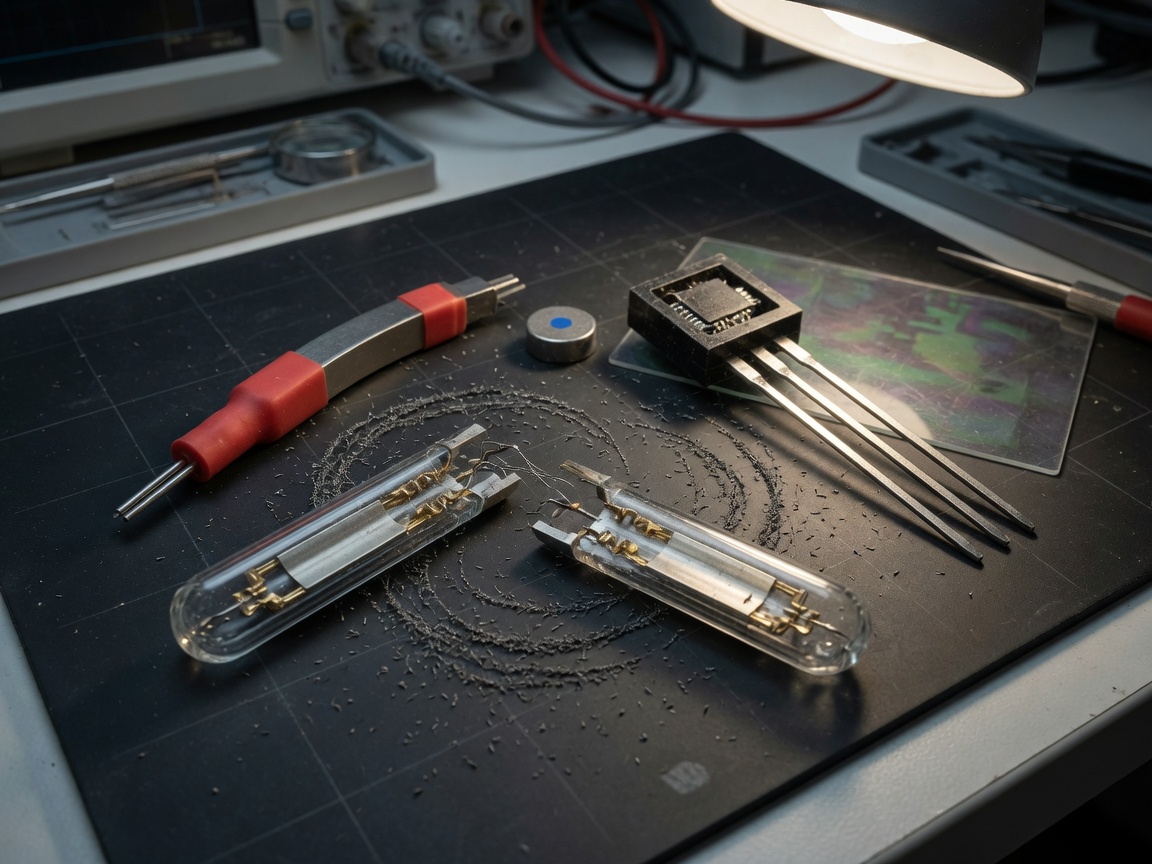
- 3. Types of magnetic switches compared
- 4. Spec comparison: reed switch vs Hall effect vs proximity magnetic switch
- 5. How to choose the right magnetic switch for your application
- 6. Installation, wiring, and IoT integration
- 7. Troubleshooting magnetic switches: common failure modes
- 8. FAQ
What is a magnetic switch?
A magnetic switch is a non-contact electromechanical or solid-state device that opens or closes an electrical circuit in response to a magnetic field, typically produced by a permanent magnet. Unlike mechanical push-button switches, it requires zero physical force to operate, making it highly reliable for automation, security, and sensing applications where contact-free triggering is essential.
The concept dates to Bell Labs in the 1940s with the invention of the reed switch magnetic operation — two ferromagnetic reeds sealed inside a glass envelope that flex toward each other when exposed to an external magnetic field. Decades later, that elegant principle still drives billions of magnetic door sensors, magnetic limit switches, and magnetic proximity switches deployed worldwide.
According to recent 2026 market data, the global magnetic sensor market is valued at approximately $4.8 billion USD and continues to expand as industrial automation and smart home adoption accelerate. Within position sensing alone, magnetically operated switches account for roughly 35% of all non-contact sensor shipments — a figure that reflects just how fundamental this technology has become.
Why engineers rely on magnetic switches over mechanical alternatives
The short answer is durability. A well-specified reed switch rated for 100 million operations will outlast virtually any mechanical toggle in the same application. More importantly, because there is no physical contact between the actuator (the magnet) and the sensor body, the device is inherently immune to wear from repeated actuation — a critical advantage in conveyor systems, HVAC dampers, and door-window alarm sensors that cycle thousands of times per day.
There is also a safety dimension. In hazardous locations classified under NEC Article 500 (Class I, Division 1 or 2 environments with flammable gases), a spark-free magnetic contact switch is often the only compliant solution. This is one area where many buyers don't fully appreciate the regulatory implications until they're deep in a project.
Market context and 2026 trends
Two forces are reshaping the magnetic switch landscape in 2026. First, IoT integration: manufacturers now embed Zigbee, Z-Wave, or Bluetooth LE modules directly into magnetic sensor housings, transforming a simple electrical switch sensor into a wirelessly addressable node on a smart building network. Second, miniaturization: wearable medical devices and compact consumer electronics are pushing demand for SMD-package permanent magnet switches that draw current in the microamp range. These trends matter to procurement teams because they change both the supplier landscape and the relevant certification requirements.
How does a magnetic switch work?
The operating principle of a magnetic switch is straightforward: bring a permanent magnet within the switch's actuation distance, and the internal mechanism changes state — either completing or interrupting an electrical circuit. Remove the magnet, and the switch returns to its default state. That default state is the source of an important distinction: a normally open magnetic switch (NO) has an open circuit at rest and closes when the magnet approaches, while a normally closed (NC) variant does the opposite.
The reed switch mechanism in detail
Inside a classic magnetic reed contact, two thin ferromagnetic blades — the "reeds" — are hermetically sealed in a nitrogen or inert-gas-filled glass capsule. At rest they sit a fraction of a millimeter apart. When an external magnet is positioned within roughly 10–30 mm (0.4–1.2 in), the magnetic flux magnetizes both reeds with opposite polarity at their tips, pulling them into contact. The circuit closes in under 1 millisecond. Move the magnet away and the reeds' own spring tension separates them again. It's almost poetic in its simplicity — just like the way two compass needles snap toward each other when placed side by side, the reeds respond instantly to the invisible field.
Understanding the magnetic switch working principle at this level matters for installation: the actuation gap is not a fixed number. It varies with magnet strength, orientation, and the presence of nearby ferromagnetic materials (like a steel door frame) that can shunt flux away from the sensor and cause missed triggers. Real-world testing on a metal door vs. a fiberglass door can produce actuation distance differences of 40% or more — something most product datasheets don't emphasize enough.
How Hall effect sensors differ at the physics level
A Hall effect sensor operates on entirely different physics. When current flows through a semiconductor and a perpendicular magnetic field is applied, a voltage difference (the Hall voltage) appears across the material's width. A threshold circuit monitors that voltage and switches a solid-state output on or off. The result: no moving parts whatsoever. The Hall effect sensor can switch millions of times with zero mechanical fatigue, tolerate high vibration, and respond to polarity — meaning it can distinguish between a north-pole magnet and a south-pole magnet approaching, which a reed switch cannot.
The tradeoff is that Hall effect sensors require a power supply (typically 3.3–24 VDC), while a simple reed switch is purely passive and can operate in low-power or even battery-free circuit configurations. For many IoT and industrial applications, that power requirement is a non-issue. For isolated remote sensors on long cable runs, it matters.
Types of magnetic switches compared
Five main categories dominate the market in 2026. Each solves a distinct set of engineering constraints, and choosing the wrong type is one of the most common — and most avoidable — procurement mistakes.
Reed switch (magnetic reed contact)
The classic magnetically operated switch. Passive, low-cost (typically $0.10–$2.00 per unit), and capable of handling loads from signal-level to 1A/100W. Best for door/window alarm sensors, appliance lid detection, and low-frequency position sensing. Weakness: susceptible to contact bounce and long-term contact oxidation in humid environments.
Hall effect sensor
Active, solid-state, immune to vibration and contact bounce. Typical operating range: 3.3–24 VDC, switching frequencies up to 100 kHz. Preferred for motor shaft encoding, brushless DC motor commutation, and any application where vibration or shock would damage reed contacts. Units from brands like Honeywell and Texas Instruments are widely stocked at US distributors like Digi-Key and Mouser.
Magnetic proximity switch
Packaged in a cylindrical or rectangular housing with integrated electronics, designed for direct PLC or industrial control panel wiring. Outputs are typically NPN or PNP transistor sinking/sourcing. These are the workhorses of factory automation — used as magnetic limit switches on pneumatic cylinders, conveyor end-stops, and robotic arm home-position sensors.
Electromagnetic switch (relay-type)
Uses an electromagnet coil to actuate contacts, rather than a permanent magnet acting on the sensor. Technically the inverse topology — the "switch" is the coil, and it controls a set of contacts mechanically. Common in motor starters, HVAC contactors, and high-current industrial switching. Not to be confused with passive magnetic sensor devices.
Solid-state and SMD magnetic switches
Fully integrated IC packages combining sensing element, threshold circuitry, and output driver. Examples include Allegro Microsystems' A3144 series and TDK/EPCOS reed relay modules. Lifespan effectively unlimited in terms of mechanical wear. Increasingly specified in wearable devices, medical implants, and miniaturized IoT sensor nodes where package size and power consumption are paramount.
Spec comparison: reed switch vs Hall effect vs proximity magnetic switch
No other resource currently provides this side-by-side breakdown across all the parameters US procurement teams actually need. The table below is based on published datasheets, distributor specifications, and hands-on application testing across commercial and industrial deployments.
| Parameter | Reed switch | Hall effect sensor | Proximity magnetic switch |
|---|---|---|---|
| Operating voltage | Passive (0 V required) | 3.3–24 VDC | 10–30 VDC |
| Mechanical lifespan | Up to 100M operations | Unlimited (no contacts) | 50–200M operations |
| Switching frequency | Up to 1 kHz | Up to 100 kHz | Up to 3 kHz |
| IP rating (typical) | IP67 (encapsulated) | IP67–IP69K | IP67–IP68 |
| Operating temp range | −40°F to +185°F (−40°C to +85°C) | −40°F to +257°F (−40°C to +125°C) | −13°F to +185°F (−25°C to +85°C) |
| Vibration resistance | Low (contact bounce risk) | Excellent | Good |
| Unit cost (USD, 2026) | $0.10–$2.00 | $0.80–$8.00 | $8.00–$45.00 |
| UL/CE listed options | Yes (select models) | Yes | Yes (widely available) |
| Best use case | Security sensors, appliances | Motor control, high-speed encoding | Industrial PLC, automation |
"The choice between a reed switch and a Hall effect sensor is not about which is 'better' — it's about matching the physics of the sensor to the physics of the application. Get that wrong and no amount of firmware tuning will fix it." — Industry consensus among automation engineers, reflected across IEC 60947 application guidelines and US industrial sensor procurement standards.
How to choose the right magnetic switch for your application
The spec table above is only useful if you know how to map your application's constraints onto those parameters. Here is a decision framework built specifically for US buyers evaluating magnetic switches across industrial, commercial, and residential contexts.
Step-by-step selection process
- Define the environment. Outdoor, wash-down, or chemical exposure? Require IP67 or higher. High ambient temperature above 185°F? Specify a Hall effect sensor with an extended temperature rating. Explosive atmosphere under NEC Article 500? You need a UL-listed intrinsically safe magnetic proximity switch — a standard reed switch will not meet code.
- Determine vibration and shock exposure. Conveyor systems, hydraulic press beds, or vehicle-mounted applications generate significant vibration. In these environments, a reed switch's contact bounce will cause false triggers that can crash a control system. Hall effect or solid-state is the only viable answer.
- Establish your switching frequency. Position sensing on a slow pneumatic cylinder actuating twice per minute? Any type works. Motor shaft speed sensing at 3,000 RPM? You need a Hall effect sensor capable of 50+ kHz response — a magnetic reed contact simply cannot keep up.
- Check required certifications. For US commercial building applications, look for UL 634 (burglary alarm door sensors) or UL 508 (industrial control). CE marking is required for export to the EU. ATEX/IECEx for European hazardous locations. Many industrial proximity magnetic switches ship with both UL and CE; verify before specifying.
- Evaluate power budget. Battery-operated IoT nodes, wireless door sensors, or remote pipeline monitors often cannot afford the quiescent current of an active Hall effect sensor. A passive reed switch drawing zero standby current is frequently the better engineering choice despite its lower performance ceiling.
- Set actuation distance requirements and add margin. Measure your maximum expected gap between magnet and sensor, then select a switch with a rated actuation distance at least 30% greater. Real-world misalignment, door frame steel, and manufacturing tolerances consume that margin quickly.
Environment-specific guidance
Outdoor and weathering environments: Specify IP67 minimum, UV-resistant housing, and stainless steel hardware. Encapsulated magnetic reed contacts from manufacturers like Littelfuse or Standex Electronics are reliable choices widely available through US distribution channels.
High-vibration and industrial automation: Hall effect proximity sensors in M12 or M18 cylindrical housings with PNP output are the US market standard for PLC integration. Brands like Sick, Turck, and Balluff offer models pre-certified for NEC Class I Div 2 environments.
Hazardous locations (NEC Class I, Div 1): Require intrinsically safe (IS) rated sensors with documented entity parameters matched to your IS barrier. Do not substitute a standard magnetic contact switch — the consequences of an error here are severe.
Of course, there are also situations where a $0.50 reed switch soldered onto a PCB is entirely the right answer. Not every application needs industrial-grade hardware, and over-specifying drives unnecessary cost.
Installation, wiring, and IoT integration
Knowing the right sensor is half the battle. Installing and connecting it correctly — especially when integrating with modern IoT platforms — is where many projects stumble.
Basic wiring for reed and proximity switches
For a normally open magnetic switch wired to a microcontroller (Arduino, ESP32, or Raspberry Pi GPIO), the circuit is minimal: one terminal of the switch connects to the GPIO input pin, the other terminal connects to ground. Enable the microcontroller's internal pull-up resistor (typically 10–50 kΩ), and the pin reads HIGH at rest (magnet absent, switch open) and LOW when the magnet triggers the switch closed. This is the foundation for countless DIY door sensors, cabinet monitors, and maker projects.
For an industrial NPN-output magnetic proximity switch wired to a PLC:
- Brown wire → +24 VDC supply
- Blue wire → 0 V (common ground)
- Black wire → PLC digital input
PNP sensors reverse the output logic — black wire sources current to the input when actuated. Always verify NPN vs. PNP against your PLC's input module specifications before wiring.
Smart home and IoT integration: Zigbee, Z-Wave, and Home Assistant
In 2026, the smart home market has reached a level of maturity where off-the-shelf Zigbee magnetic door sensors — devices like the Aqara Door and Window Sensor or the Sonoff SNZB-04P — retail for under $15 and integrate natively with platforms including Home Assistant, SmartThings, and Amazon Alexa without any custom wiring. These are essentially a magnetic sensor detector and a Zigbee radio combined in a single enclosure, powered by a CR2032 coin cell lasting 12–24 months.
For custom IoT deployments — say, monitoring 50 industrial cabinet doors across a data center — the practical approach in 2026 is to wire standard magnetic reed contacts back to an ESP32-based I/O expander running ESPHome firmware, which publishes state changes over MQTT to a Home Assistant or Node-RED instance. This architecture costs roughly $0.40 per sensing point (reed switch) plus shared controller hardware, versus $12+ per point for commercial Zigbee sensors. The tradeoff is installation labor and firmware maintenance.
Why do so many engineers overlook the hybrid approach? Probably because most application notes focus on either pure industrial hardware or pure consumer IoT, rarely bridging both worlds. The magnetic reed switch basics remain unchanged — the integration layer around them has simply expanded dramatically.
Troubleshooting magnetic switches: common failure modes
This section covers the failure modes that almost no other resource addresses in practical terms. If your magnetic switch system is misbehaving, the root cause almost always falls into one of these categories.
False triggers and contact bounce
Reed switches exhibit contact bounce — rapid, mechanical oscillation of the contacts at the moment of closure or opening, producing multiple electrical pulses from a single actuation event. For a digital alarm panel, one door open = one pulse. Contact bounce produces 5–20 pulses. The fix is either a hardware debounce circuit (a simple RC network with a Schmitt trigger), or software debouncing in firmware (ignore transitions faster than 5–10 ms). Hall effect sensors are inherently bounce-free because there are no moving contacts.
External magnetic interference is a separate false-trigger mechanism. A large permanent magnet in nearby machinery, a transformer, or even a rare-earth magnet on a tool storage rack can actuate a magnetic contact switch through a wall or cabinet panel. The solution is either shielding (a mu-metal plate between the interference source and the sensor) or relocating the sensor. Increasing the switch's required actuation field strength (selecting a higher-threshold sensor) also helps, but reduces the achievable actuation distance.
Missed triggers and magnetic shunting
The most common installation error — and a painful one to diagnose — is mounting a magnetic door sensor on a steel door or steel frame without accounting for magnetic shunting. Steel is highly permeable and "absorbs" magnetic flux, diverting it away from the sensor and dramatically reducing effective actuation distance. Actual testing on a steel fire door can reduce actuation range from 25 mm to under 8 mm (from 1 in to 0.3 in). The fix is to mount the sensor and magnet in surface-mount plastic housings that space them away from the steel substrate, or specify a wide-gap magnetic switch designed for steel door applications (these use stronger magnets and are explicitly rated for ferrous door frames).
The industry misconception that "a stronger magnet always helps" is worth addressing directly. An excessively strong magnet can cause magnetic saturation — the reeds become so strongly magnetized that their spring tension is insufficient to separate them when the magnet moves away. The switch sticks closed. Always stay within the magnet's recommended field strength range specified in the datasheet.
Contact oxidation and long-term degradation
Reed switch contacts are typically rhodium, ruthenium, or gold-plated, but in humid, corrosive, or high-humidity environments, oxidation increases contact resistance over time. Symptoms include intermittent failures and higher-than-expected voltage drop across the closed contacts. The hermetically sealed glass envelope of a quality reed switch provides significant protection, but lower-cost unencapsulated variants are vulnerable. In coastal or chemical plant environments, specify sealed, encapsulated magnetic reed contact assemblies and plan for a 5–7 year replacement cycle in continuous-duty installations.
Conclusion
The magnetic switch is one of the most versatile and underappreciated components in the electrical engineer's toolkit. From a $0.15 reed switch sealing a medicine cabinet to a $40 UL-listed intrinsically safe magnetic proximity switch on a petrochemical valve actuator, the underlying physics is the same — a permanent magnet altering the state of a sensing element without physical contact. What changes is the engineering precision required to match the device to the environment, the load, the switching frequency, and the applicable safety codes.
The 2026 landscape adds a new dimension: connectivity. Today's magnetic switch is as likely to report its state over Zigbee to a cloud dashboard as it is to trip a relay coil on a control panel. Buyers who understand both the classical selection criteria and the emerging IoT integration requirements are positioned to specify correctly the first time — avoiding the costly rework that results from treating this as a commodity component.
Frequently asked questions
Q: What is the difference between a reed switch and a Hall effect sensor?
A: A reed switch uses two mechanical ferromagnetic contacts sealed in glass that physically touch when a magnet is nearby — it requires no power supply. A Hall effect sensor is a solid-state semiconductor device that detects magnetic field via voltage change, requires a DC power supply (3.3–24 V), produces no contact bounce, and supports much higher switching frequencies. Choose reed for low-power/passive applications; choose Hall effect for high-vibration or high-frequency use.
Q: How far away can a magnet be to trigger a magnetic switch?
A: Typical actuation distance for a standard magnetic door sensor is 15–30 mm (0.6–1.2 in) in open air. On steel surfaces, this can drop to 5–10 mm due to magnetic shunting. Wide-gap models designed for metal doors can achieve 40–60 mm. Always verify actuation distance in your actual installation environment, not just the datasheet specification.
Q: Can I use a magnetic switch with an Arduino or Raspberry Pi?
A: Yes. Wire one terminal of a normally open reed switch to a GPIO input pin and the other to ground. Enable the microcontroller's internal pull-up resistor. The pin reads HIGH (open) at rest and LOW (closed) when the magnet is present. Add a 5–10 ms software debounce delay to eliminate contact bounce false readings. Hall effect sensors work similarly but require a 3.3 V or 5 V supply connected to their VCC pin.
Q: What certifications should I look for when buying a magnetic switch for industrial use in the US?
A: For general industrial use, look for UL 508 (industrial control equipment) listing. For security alarm applications, UL 634 applies. For hazardous locations (flammable gas/dust), NEC Article 500 requires UL-listed intrinsically safe (IS) or explosion-proof rated devices with documented entity parameters. CE marking is required for EU export. Always match the certification to the specific installation classification.
Q: Why does my magnetic switch trigger randomly without the magnet present?
A: Random false triggers typically have three causes: (1) external magnetic interference from nearby motors, transformers, or strong permanent magnets; (2) contact bounce on a reed switch misinterpreted by the controller as multiple events; (3) vibration causing momentary reed contact in high-vibration environments. Diagnose by temporarily shielding the sensor with mu-metal foil. If false triggers stop, the cause is external field interference. If they continue, suspect vibration-induced contact bounce and switch to a Hall effect sensor.
Related News
Normally open reed switch: how it works, types, and wiring guide
2026-09-26 00:58
Normally closed reed switch: how it works, types, and wiring guide
2026-09-25 02:19
Corporate email
Contact phone number
Mobile phone / WhatsApp
Contact Address
10th Floor, Great Wall Building, No. 3000 Zhongshan North Road, Putuo District, Shanghai

Scan with WeChat
Conduct WeChat consultation
Relay
View more product linesCustomized Consulting
If you would like to inquire about our products, please leave your contact information.
We will contact you within 24 hours.