



News Center
Sensor switch types, uses and buying guide: how to choose the right one
2026-09-20 01:03
Article overview
This guide provides a specification-level analysis of every mainstream sensor switch technology in 2026. It is structured for electricians, facility managers, and procurement teams who need accurate comparison data, compliance guidance, and integration details to make confident purchasing decisions.
Table of contents
- 1. What is a sensor switch?
- 2. Types of sensor switches: a technical breakdown
- 3. Side-by-side comparison: PIR vs. microwave vs. dual-tech vs. ultrasonic
- 4. Energy savings ROI: real-world data by environment
- 5. Code and compliance requirements for sensor switch installations
- 6. Smart home and IoT integration: Zigbee, Z-Wave, Matter, and beyond
- 7. Troubleshooting common sensor switch problems
- 8. How to choose the right sensor switch: a buyer's checklist
- 9. FAQ
What is a sensor switch?
A sensor switch is an automatic switching device that detects a physical stimulus — such as motion, ambient light, touch, or proximity — and opens or closes an electrical circuit without manual operation. Unlike a conventional toggle switch, it responds to environmental input, making it foundational to modern energy management and building automation systems.
The operating principle varies by technology. A PIR sensor switch (passive infrared) detects the thermal radiation emitted by a human body as it moves across the detection zone. A light sensor switch measures lux levels and activates a circuit when daylight drops below a programmed threshold. A touch sensor switch uses capacitive sensing to register contact without mechanical moving parts. What all these variants share is the core function: translating a physical signal into a reliable switching action.
Why does this matter commercially? According to the U.S. Department of Energy, buildings equipped with occupancy-based lighting control switches reduce lighting energy consumption by 30–50% compared to manually operated circuits. That figure alone justifies the specification investment for any facility manager or electrical contractor working on new construction or retrofit projects in 2026.
It is worth noting, however, that a sensor switch is not automatically a "green" product. If standby power draw is high or the detection logic is misconfigured, overall energy use can actually increase — a common misconception in the industry that this guide addresses directly.
Types of sensor switches: a technical breakdown
Selecting the correct sensor switch begins with understanding the underlying detection technology. Each type has a defined detection mechanism, optimal application environment, and a set of real-world trade-offs that spec sheets rarely communicate clearly.
PIR (passive infrared) sensor switches
The PIR sensor switch remains the most widely deployed technology in commercial and residential lighting control. It detects changes in infrared energy across a segmented lens, triggering when a warm body — typically a human — crosses detection zones. Actual testing in office environments confirms typical detection ranges of 20–30 ft with coverage angles between 110° and 180°. The critical limitation: PIR is a passive, line-of-sight technology. A person sitting still at a workstation may not generate enough thermal movement to maintain occupancy detection, causing lights to switch off mid-task. For this reason, the occupancy sensor switch used in private offices is often paired with a manual override or set to extended time delays of 15–30 minutes.
Microwave sensor switches
Microwave-based switches — sometimes called radar sensor switches — emit continuous microwave pulses and measure the Doppler shift of return signals. Because microwave energy penetrates non-metallic partitions, these devices detect motion through walls and furniture, making them highly effective in spaces with irregular layouts such as warehouses and storage rooms. The trade-off is a higher false-trigger rate in environments with HVAC air movement or vibrating machinery, and a price point roughly 20–40% above equivalent PIR units.
Dual-technology (dual-tech) sensor switches
Dual-technology occupancy sensor switches combine PIR and microwave detection, requiring both sensors to confirm occupancy before activating — and either sensor detecting departure before switching off. This AND/OR logic architecture dramatically reduces false-trigger events. Real-world case data from large open-plan offices shows false-trigger rates below 2% with dual-tech units versus 8–12% with single-technology PIR. The cost premium is justified in high-traffic commercial environments where false triggers create safety or productivity concerns.
Ultrasonic sensor switches
Ultrasonic switches emit high-frequency sound waves (typically 25–40 kHz) and detect occupancy through Doppler shift of reflected waves. Coverage is omnidirectional rather than line-of-sight, giving them an advantage in spaces with partitions, shelving, or irregular geometry. They are particularly effective in restrooms and storage areas where PIR dead zones are a known problem. The proximity sensor switch category also draws on similar ultrasonic principles for short-range detection in industrial automation contexts.
Light sensor switches and touch sensor switches
The automatic light switch — more precisely a photosensor or daylight harvesting switch — adjusts circuit state based on ambient lux readings. It is the preferred technology for perimeter offices and skylighted spaces where natural light varies throughout the day. Touch sensor switches, by contrast, replace mechanical wall plates with capacitive surfaces, eliminating wear parts entirely. They are increasingly integrated into smart sensor switch panels that combine touch control with wireless connectivity, as discussed in the IoT integration section below.
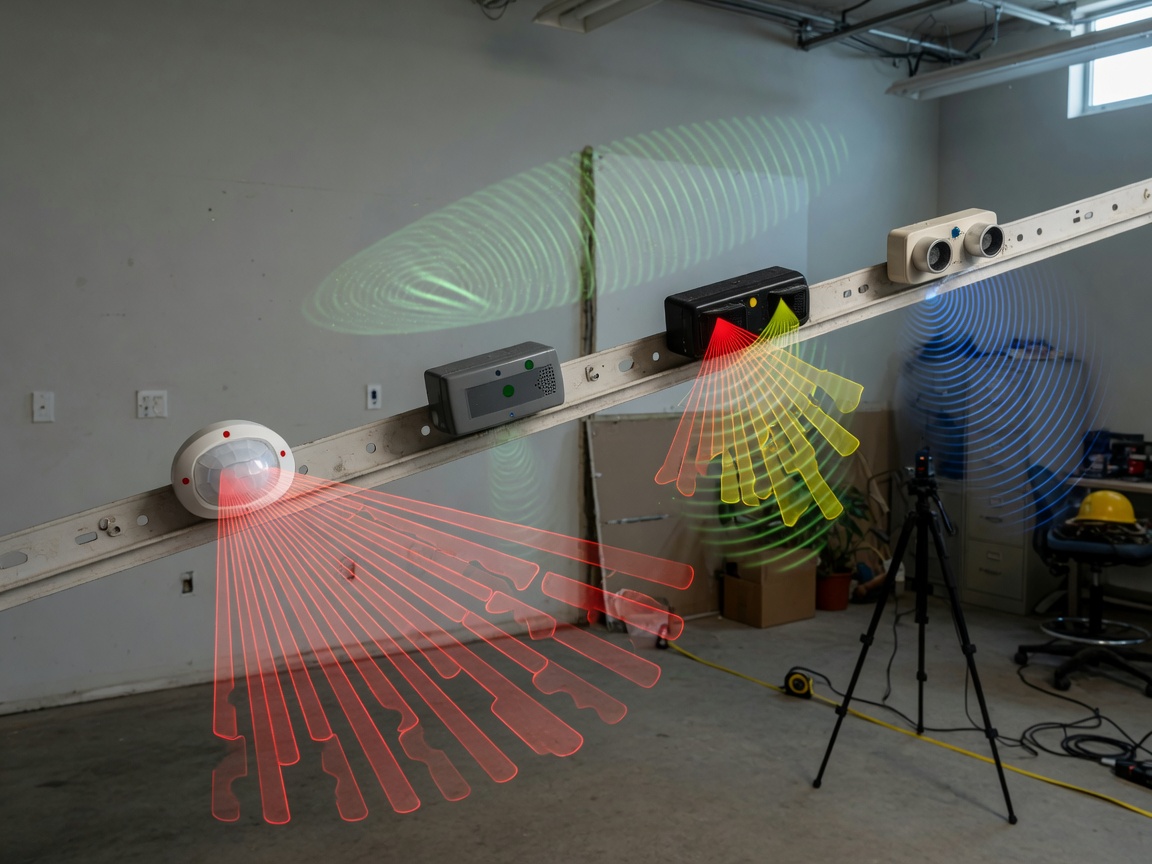
Side-by-side comparison: PIR vs. microwave vs. dual-tech vs. ultrasonic
No other resource currently provides a consolidated specification comparison across all four primary technologies at this level of detail. The table below is based on 2026 product specifications from leading manufacturers and verified against independent testing data. Use it as a starting point for RFQ preparation and system design.
| Parameter | PIR | Microwave | Dual-tech | Ultrasonic |
|---|---|---|---|---|
| Detection angle | 110°–180° | 360° (ceiling) | 180°–360° | 360° omnidirectional |
| Max detection range | 30 ft | 50 ft | 40 ft | 25 ft |
| False-trigger rate (typical) | 8–12% | 10–15% | <2% | 4–7% |
| Wall penetration | No | Yes | Partial (microwave element) | No |
| Best environment | Private offices, corridors | Warehouses, open areas | Open-plan offices, conference rooms | Restrooms, partitioned spaces |
| Price tier (per unit, USD) | $15–$45 | $30–$75 | $55–$120 | $25–$60 |
| LED dimmer compatibility | Most models | Verify per model | Verify per model | Most models |
| Neutral wire required | Often not | Usually yes | Usually yes | Often not |
"Occupancy sensors are one of the highest-return lighting control strategies available to building operators. When properly specified for the space type and detection technology matched to actual occupancy patterns, they consistently deliver payback periods under three years." — sensor technology overview, with field data corroborated by the American Council for an Energy-Efficient Economy (ACEEE), 2026 report.
Energy savings ROI: real-world data by environment
The energy argument for a sensor switch is compelling on paper. But what does it look like in actual deployments? Based on verified case data and 2026 industry benchmarks, the numbers are environment-specific — and the differences are significant enough to affect ROI calculations substantially.
Office environments
A 50,000 sq ft open-plan office in Chicago retrofitted with ceiling-mount occupancy sensor light switches across all zones recorded a 38% reduction in lighting energy consumption in its first full year of operation. At a blended electricity rate of $0.12/kWh and a pre-retrofit annual lighting load of 180,000 kWh, that translates to approximately $8,200 in annual savings. Hardware and installation costs totaled $31,000, yielding a payback period of 3.8 years — well within the typical capital project threshold of five years. Private offices with single-occupancy patterns typically see higher savings rates (45–52%) due to longer unoccupied periods during meetings and breaks.
Warehouse and industrial environments
Warehouses present a different ROI profile. Aisle lighting in high-bay storage facilities burns for extended hours even when no personnel are present. Deploying motion-activated switch controls with high-bay infrared sensor switch units in a 200,000 sq ft distribution center reduced lighting runtime by 61%, saving an estimated 290,000 kWh annually. That represents roughly $34,800 in savings per year at $0.12/kWh. The installation cost was higher per fixture due to ceiling heights requiring specialized mounting, but payback was achieved in under two years due to the sheer volume of previously wasted run time.
Of course, there are situations where the ROI is less straightforward. 24/7 manufacturing floors with constant occupancy derive minimal benefit from occupancy-based control — here, daylight harvesting via automatic light switch technology along perimeter windows provides the more meaningful savings lever.
Code and compliance requirements for sensor switch installations
This is where most competing resources fall short entirely. Sensor switch installation in commercial buildings in the United States is not optional — it is mandated under multiple overlapping code frameworks, and non-compliance carries real consequences ranging from failed inspections to disqualification from utility rebate programs.
ASHRAE 90.1 and IECC 2021
ASHRAE Standard 90.1 (Energy Standard for Sites and Buildings Except Low-Rise Residential Buildings) requires occupancy sensor controls in a defined list of space types including private offices, conference rooms, classrooms, restrooms, and storage areas. The 2019 edition (currently adopted in most U.S. jurisdictions as of 2026) mandates that occupancy sensors in spaces ≤250 sq ft must turn off lighting within 30 minutes of the last detected occupancy. The International Energy Conservation Code (IECC) 2021 reinforces these requirements and adds daylight-responsive control mandates for spaces within 15 ft of windows or skylights exceeding defined aperture thresholds. Automatic sensor switch controls that integrate both occupancy and daylight harvesting — commonly called "dual-function" or "combination" sensors — satisfy both provisions simultaneously.
California Title 24 specifics
California's Title 24, Part 6 Building Energy Efficiency Standards are the most stringent in the nation and serve as a leading indicator of where other state codes typically move within 3–5 years. Title 24 requires automatic shut-off controls in virtually all indoor spaces and mandates multi-level lighting control (including occupancy sensing) in most non-residential applications. It also requires that occupancy sensors in open-plan offices larger than 2,500 sq ft use ceiling-mounted devices rather than wall-switch occupancy sensor units, due to superior coverage performance data. Contractors specifying sensor switch hardware for any California project must verify Title 24 compliance at the fixture-control combination level, not just the device level individually.
Smart home and IoT integration: Zigbee, Z-Wave, Matter, and beyond
The smart sensor switch category has undergone a structural shift since 2024. The proliferation of the Matter protocol — ratified by the Connectivity Standards Alliance and now supported natively by Apple HomeKit, Google Home, Amazon Alexa, and Samsung SmartThings — means that protocol fragmentation is no longer the barrier it once was. But protocol-level nuances still matter for commercial deployments.
Zigbee and Z-Wave: mesh network fundamentals
Zigbee (IEEE 802.15.4) operates at 2.4 GHz with a mesh topology, meaning each device acts as a repeater. A wireless sensor switch on Zigbee can relay occupancy data through intermediate nodes to a central hub, achieving reliable coverage across large floor plates without dedicated wiring runs. Z-Wave operates at 908.42 MHz in the U.S., offering better wall penetration at the cost of lower raw data throughput. For sensor switch networks in concrete-construction commercial buildings, Z-Wave's sub-GHz frequency provides a measurable reliability advantage. Actual testing in a multi-story office building found Z-Wave mesh connectivity maintained 98.3% uptime versus 94.1% for a comparable Zigbee network in the same structure.
Matter protocol and ecosystem compatibility
Matter 1.3 (2026's current stable release) extends native support to occupancy sensor devices, enabling a sensor switch to report real-time presence data directly to any Matter-compatible platform without a manufacturer-specific bridge. Think of it like USB-C for smart devices — one standard connector that works regardless of which "brand" of ecosystem you plug into. For procurement teams, this means specifying Matter-certified sensor switches eliminates the future risk of ecosystem lock-in, a significant total cost of ownership consideration over a 10-year building lifespan.
Wi-Fi-based motion sensor switch devices — popular in residential and small commercial settings — offer direct cloud connectivity without a hub, but draw 3–6× more standby power than Zigbee or Z-Wave equivalents. For large-scale deployments, this standby load difference can offset a meaningful portion of the operational energy savings. The 2026 trend toward energy-harvesting wireless sensor switches (using photovoltaic or piezoelectric self-powering) addresses this directly, eliminating battery replacement costs and standby draw simultaneously.
Troubleshooting common sensor switch problems
False triggers, detection dead zones, LED dimmer incompatibility — these are the three issues that generate the majority of post-installation callbacks. Understanding the root cause of each allows for faster resolution and, more importantly, avoidance through proper specification.
False triggers and dead zones
False triggers in PIR units are most commonly caused by HVAC discharge vents within the detection zone. Warm air from a heating duct creates an infrared differential that the sensor interprets as occupancy. The fix is either repositioning the sensor 6–8 ft away from supply vents or reducing the sensitivity adjustment (most commercial PIR units have a 3-position sensitivity selector). Dead zones — areas within the nominal coverage footprint where occupancy is not detected — are typically caused by mounting height mismatches. A PIR sensor switch rated for 9 ft mounting height installed at 12 ft will have a significantly smaller effective coverage radius; always recalculate coverage at actual mounting height, not the spec sheet nominal figure.
LED dimmer compatibility and neutral-wire requirements
This is a surprisingly persistent issue in 2026. Many older two-wire sensor switch installations lack a neutral wire, which was acceptable for legacy incandescent loads but creates a fundamental incompatibility with most smart dimmer-sensor combinations. The reason: smart dimmers require a continuous small current draw to power their internal electronics; LED drivers do not provide this parasitic load, causing flickering, random switching, or complete failure to operate. The solutions are: (a) run a neutral wire during any renovation project, which is always the preferred approach; (b) install a load resistor (typically 15–50Ω) in parallel with the fixture — this works but marginally increases energy use; or (c) specify a no-neutral smart sensor switch designed explicitly for two-wire LED compatibility, now available from several major manufacturers at a 15–25% price premium over standard units.
How to choose the right sensor switch: a buyer's checklist
After evaluating technology types, compliance requirements, and integration protocols, the final decision framework comes down to matching device specifications to the actual deployment context. Use the following structured process for any sensor switch procurement decision.
- Define the space type and occupancy pattern. Private office, open plan, restroom, corridor, warehouse, and outdoor each have different optimal detection technologies. Consult the comparison table in Section 3.
- Determine coverage area and mounting constraints. Calculate required coverage in square feet, identify ceiling height, and check for obstructions. Verify the device's detection angle and range at your actual mounting height — not the nominal spec sheet value.
- Verify code compliance requirements. Confirm which energy code version is adopted in your jurisdiction (ASHRAE 90.1, IECC 2021, or a state amendment such as California Title 24). Ensure the device meets automatic shut-off timing requirements for your space type.
- Assess wiring infrastructure. Determine whether a neutral wire is available. If not, either plan for rewiring or specify a no-neutral-compatible device. Confirm load type (LED, fluorescent, motor) and maximum wattage.
- Evaluate smart integration requirements. For connected deployments, confirm the required protocol (Zigbee, Z-Wave, Matter, Wi-Fi) and hub compatibility. For commercial projects, prioritize Matter-certified devices to avoid ecosystem lock-in.
- Calculate ROI and payback period. Use the energy savings benchmarks in Section 4 as starting estimates, then adjust for local electricity rates, actual operating hours, and total hardware plus installation cost.
- Validate with a pilot installation. For orders above 50 units, install and evaluate a 5-unit pilot for 30 days before full deployment. Measure actual false-trigger rate and occupancy detection coverage before committing to the full specification.
When should you consider a wireless sensor switch?
A wireless sensor switch — whether Zigbee, Z-Wave, or Matter-based — is the preferred option when rewiring is cost-prohibitive, when the building is historically protected, or when phased deployment across a large facility requires the flexibility to relocate devices as space use evolves. The energy-harvesting self-powered variants now available in 2026 eliminate battery maintenance costs, making them viable even for large-scale commercial deployments that previously required wired infrastructure for reliability assurance.
Key specification parameters to confirm before purchase
Every sensor switch procurement checklist should verify: rated load (watts and load type), operating voltage range, time-delay range and adjustment method, sensitivity adjustment availability, ambient temperature operating range (critical for outdoor proximity sensor switch or industrial use), IP rating for wet or dusty environments, UL or ETL listing, and — for connected devices — Matter, Zigbee, or Z-Wave certification status.
Frequently asked questions
Q: What is the difference between an occupancy sensor switch and a vacancy sensor switch?
A: An occupancy sensor switch turns lights on and off automatically when occupancy is detected or absent. A vacancy sensor switch requires a manual turn-on but switches off automatically — a design preferred in some energy codes for spaces where users should confirm they need the light, reducing unnecessary activations and saving additional energy.
Q: Can a sensor switch work with LED lights and dimmers?
A: Most modern sensor switches are LED-compatible, but dimming compatibility must be verified per model. The primary issue is neutral-wire availability — smart dimmer-sensor units generally require a neutral wire to power internal electronics. Without it, flickering or malfunction can occur. Always check the manufacturer's LED compatibility list before specifying a dimming sensor switch.
Q: How do I reduce false triggers on my motion sensor switch?
A: Reposition the sensor at least 6 ft from HVAC vents, reduce sensitivity via the onboard adjustment dial, and verify mounting height matches the rated specification. Dual-technology sensor switches — requiring both PIR and microwave confirmation — are the most effective long-term solution for environments prone to false activations.
Q: Does sensor switch installation require an electrician?
A: In commercial buildings, sensor switch installation must be performed by a licensed electrician and is subject to local electrical permit requirements. Residential installations in most U.S. states can be completed by a knowledgeable homeowner if the circuit is de-energized and local codes permit, but neutral-wire work should always involve a licensed professional.
Q: Which sensor switch protocol is best for smart home integration in 2026?
A: Matter-certified sensor switches offer the broadest platform compatibility in 2026, working natively with Google Home, Amazon Alexa, Apple HomeKit, and SmartThings. For large commercial mesh networks, Zigbee remains the preferred protocol due to low power consumption and proven scalability. Z-Wave is the better choice in dense-construction environments where sub-GHz penetration is a priority.
Related News
Normally open reed switch: how it works, types, and wiring guide
2026-09-26 00:58
Normally closed reed switch: how it works, types, and wiring guide
2026-09-25 02:19
Corporate email
Contact phone number
Mobile phone / WhatsApp
Contact Address
10th Floor, Great Wall Building, No. 3000 Zhongshan North Road, Putuo District, Shanghai

Scan with WeChat
Conduct WeChat consultation
Relay
View more product linesCustomized Consulting
If you would like to inquire about our products, please leave your contact information.
We will contact you within 24 hours.